Location and Historical Background
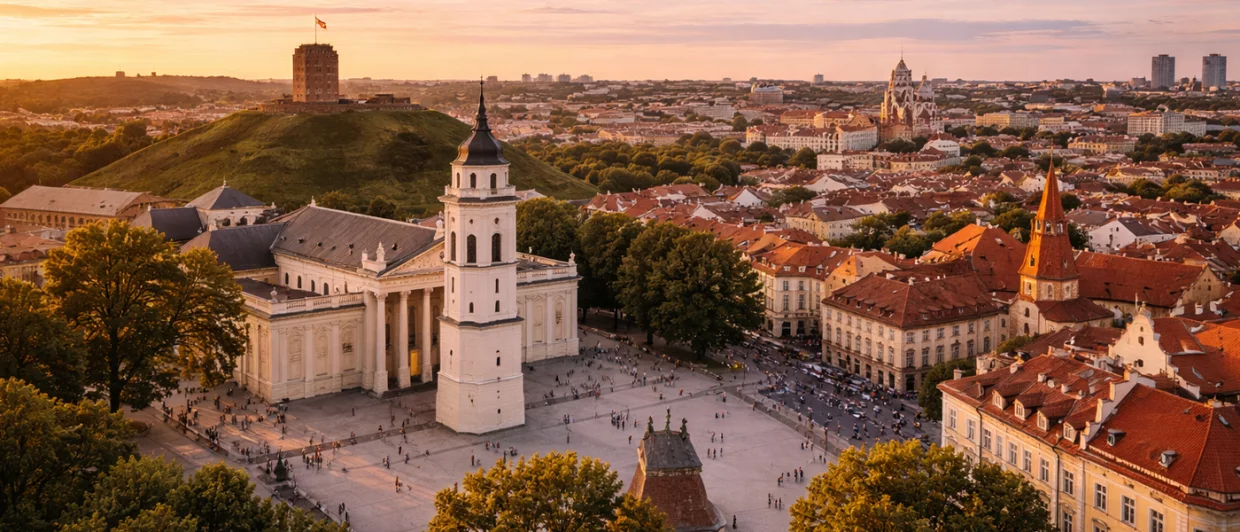
Vilnius spreads across rolling hills in southeastern Lithuania, wrapped around the gentle curves of the Neris and Vilnia rivers. Forests press close to the city edges, giving the capital a surprisingly green and intimate feel. Today, visitors are struck by its dramatic Old Town skyline, baroque towers, red rooftops, and viewpoints that reward every uphill walk.
The city was first mentioned in 1323, when Grand Duke Gediminas wrote letters inviting craftsmen and merchants from across Europe to settle here. Legend says Gediminas dreamed of an iron wolf howling atop a hill—interpreted as a prophecy that a great city would rise and be heard around the world. Vilnius was built where that wolf supposedly stood.
The Three Greatest Blows to the City
The Deluge and Wars with Moscow (1655–1661)
In 1655, Vilnius was occupied by Russian forces during the Russo-Polish War. The city was looted, burned, and depopulated. Tens of thousands were killed or fled, and Vilnius lost much of its political and economic power. Recovery took generations.
Napoleon’s Invasion (1812)
In 1812, Napoleon’s Grande Armée passed through Vilnius during its disastrous Russian campaign. The city was overwhelmed by soldiers, disease, and starvation. Retreating troops left devastation behind, and Vilnius suffered enormous civilian losses.
World War II and Occupations (1939–1944)
Vilnius endured successive Soviet and Nazi occupations. The Jewish population—once a cornerstone of the city—was almost entirely annihilated during the Holocaust in 1941–1944. The loss permanently changed the city’s cultural fabric and memory.
The Golden Age of Vilnius
Vilnius experienced its golden age in the 16th and early 17th centuries as the capital of the Grand Duchy of Lithuania. It became a major political, cultural, and educational center, crowned by the founding of Vilnius University in 1579. Religious tolerance, trade, and scholarship turned the city into one of Eastern Europe’s most vibrant capitals.
Why Vilnius Is Worth Visiting Today
Modern Vilnius is confident, creative, and quietly rebellious. Its Old Town is one of the largest in Europe, while neighborhoods like Užupis embrace artistic freedom and humor. Cafés spill into courtyards, contemporary galleries sit beside centuries-old churches, and the city feels lived-in rather than staged.
In summary, Vilnius rewards curiosity. The more time you give it, the more it gives back—stories, perspectives, and moments that feel unexpectedly personal.
Tourist Information and Must-See Sights
Estimated Prices
- Average lunch: €10–14
- Mid-range hotel (per night): €80–130
- One beer (0.5 l): €4–5
- One coffee: €3–4
The most visitor-friendly areas include the Old Town, Užupis, Gediminas Avenue, and the riverfront districts.
Must-Visit Places
Vilnius Old Town
A UNESCO-listed maze of baroque churches, courtyards, and narrow streets—one of Europe’s most atmospheric historic centers.
Gediminas Tower
Standing on Castle Hill, this tower offers the best views of the city and symbolizes Lithuanian statehood.
Užupis
A self-declared artistic republic with its own constitution, full of galleries, cafés, and playful independence.
Final Summary
Vilnius doesn’t try to be easy to understand—and that’s exactly why it works. Come expecting a city break, leave with a history lesson, a philosophical dilemma, and the strange urge to read poetry in a café courtyard.