Location and Historical Background
A peninsula kissed by the Adriatic
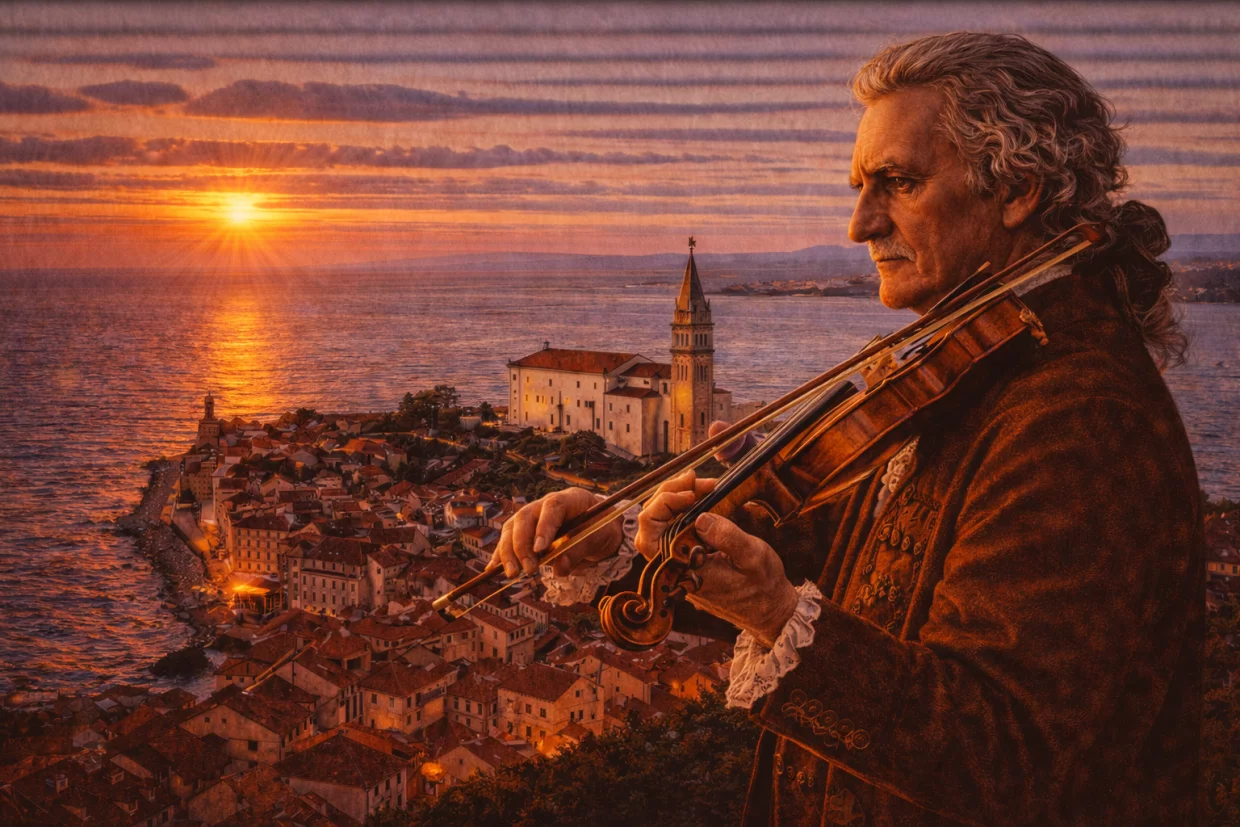
Piran occupies a slender peninsula on Slovenia’s short but spectacular Adriatic coastline. The sea wraps around the town from nearly every angle, while salt pans shimmer just beyond the horizon. Today, the setting delivers dramatic views, salty air, and sunsets that feel almost theatrical.
From Roman roots to Venetian grace
Settlements here date back to Roman times, but Piran truly flourished under Venetian rule, beginning in the 13th century. First mentioned in written sources in 983, the town grew wealthy through salt production and maritime trade. Legend claims the town prospered because it “faced the sea with respect, not fear”—a philosophy still visible in its layout and culture.
The Three Greatest Blows Piran Endured
1. Plague Epidemics (16th–17th centuries)
Like many Adriatic towns, Piran was struck repeatedly by plague outbreaks, particularly in the 1500s and 1600s. Population losses were severe, and trade periodically collapsed, forcing the town to rebuild its social fabric time and again.
2. Fall of the Venetian Republic (1797)
When Venice fell to Napoleon in 1797, Piran lost its political protector and economic framework. Control shifted rapidly between powers, bringing uncertainty and stagnation to a town built on stable maritime order.
3. Twentieth-Century Border Changes (1918–1954)
After World War I and again after World War II, Piran changed national affiliation multiple times—from Austria-Hungary to Italy, then to Yugoslavia, and finally Slovenia. Each transition reshaped identity, population, and economy.
The Golden Age
Piran’s golden age spanned the 13th to 18th centuries, when Venetian influence brought wealth, art, and elegant urban planning. Salt trade funded palaces, churches, and walls—many of which still define the town’s breathtaking silhouette.
Why Piran Is Worth Visiting Today
Today, Piran is effortlessly atmospheric. Cars stay outside the old town, life flows along the seafront, and cafés spill onto stone squares. Swimming spots replace beaches, seafood replaces haste, and history blends seamlessly with leisure. It’s not a resort—it’s a lifestyle sample.
In summary:
Piran doesn’t entertain you. It seduces you.
Tourist Information and Must-See Attractions
Estimated prices (per person):
- Average lunch: €14–18
- Mid-range accommodation (night): €80–130
- Local beer (0.5 l): €4–5
- Coffee: €3–3.50
Most interesting areas:
- Old Town peninsula
- Seafront promenade
- City walls & viewpoints
Must-Visit Highlights
Tartini Square
The elegant heart of Piran, named after violinist Giuseppe Tartini. Surrounded by pastel palaces, cafés, and the town hall, it’s the perfect starting point for exploration.
Piran City Walls
Climb the walls for the best panoramic views of red rooftops melting into the Adriatic. One of the most rewarding viewpoints on the Slovenian coast.
St. George’s Parish Church
Perched above the town, this church offers sweeping sea views and a quiet moment above the bustle—especially magical at sunset.
Final Summary
Piran is proof that you don’t need size or noise to feel grand—just the sea, the light, and a little Venetian soul.
Tags: Italy • Mediterranean • Slovenia • War