Location and Historical Background
A romantic city shaped by river and hills
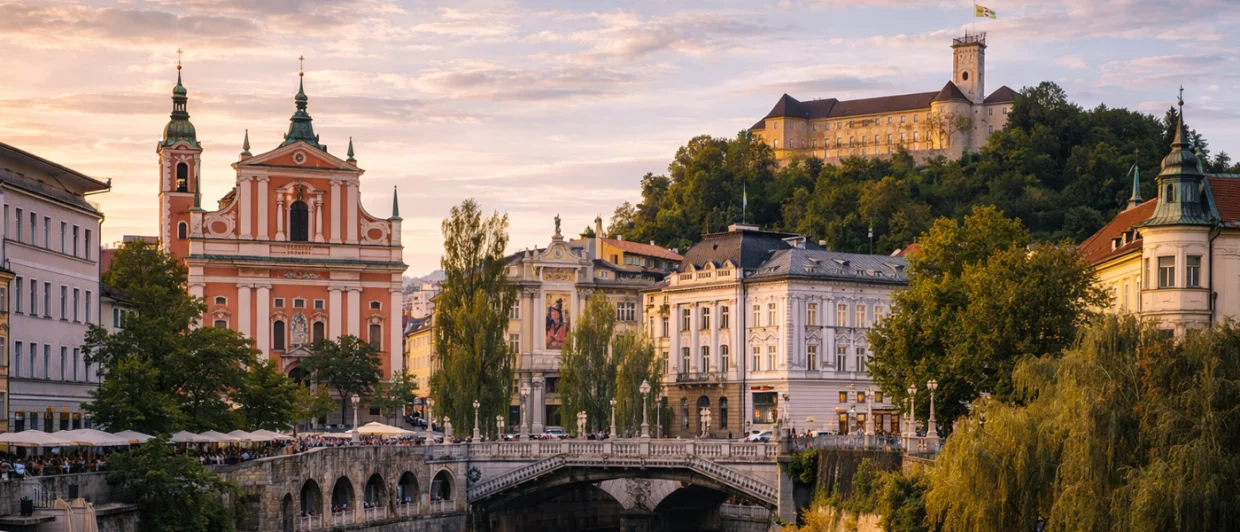
Ljubljana sits in a green basin where the Ljubljanica River gently curves through the city, watched over by Castle Hill. Forests, wetlands, and Alpine foothills surround the capital, giving it a calm, almost pastoral feel—despite its political importance. Nature here isn’t outside the city; it’s woven into daily life.
From Roman Emona to medieval town
Ljubljana’s roots stretch back to Roman Emona, founded around 14 AD. After the Roman decline, Slavic settlers arrived, and the city was first mentioned as Ljubljana in 1144. Legend says the city was founded when the Greek hero Jason defeated a dragon here—explaining why dragons still guard its bridges.
The Three Greatest Blows Ljubljana Endured
1. Earthquake of 1511
In 1511, a powerful earthquake destroyed much of medieval Ljubljana. Large sections had to be rebuilt, reshaping the city’s architectural character and forcing it to adapt to disaster early in its history.
2. The Great Earthquake of 1895
Another devastating earthquake struck in 1895, destroying around 10% of buildings and damaging many more. While tragic, it triggered a major urban renewal, giving Ljubljana its elegant Secession (Art Nouveau) architecture.
3. World War II Occupation (1941–1945)
During World War II, Ljubljana was occupied and literally encircled with barbed wire by Axis forces. Resistance, repression, and hardship marked the period, leaving deep historical memory despite relatively limited physical destruction.
The Golden Age
Ljubljana’s cultural golden age blossomed in the 20th century, particularly under architect Jože Plečnik, whose visionary designs transformed bridges, squares, and public spaces. More recently, the post-1991 independence era elevated Ljubljana into a confident European capital.
Why Ljubljana Is Worth Visiting Today
Today, Ljubljana feels thoughtfully designed for people. The Old Town is compact and lively, the riverbanks buzz with cafés, and cultural life thrives without overwhelming the city’s calm. Sustainability isn’t a slogan here—it’s visible in bike lanes, green spaces, and relaxed urban rhythm.
In summary:
Ljubljana doesn’t impress by size or noise—it wins by balance.
Tourist Information and Must-See Attractions
Estimated prices (per person):
- Average lunch: €12–16
- Mid-range accommodation (night): €70–110
- Local beer (0.5 l): €4–5
- Coffee: €3–3.50
Most interesting areas:
- Old Town & riverbanks
- Castle Hill
- Tivoli Park area
Must-Visit Highlights
Ljubljana Castle
Perched above the city, the castle offers panoramic views and insight into Ljubljana’s layered past. Accessible by funicular or a scenic walk.
Triple Bridge
An iconic architectural ensemble designed by Plečnik, connecting the Old Town with the modern city. Functional, beautiful, and uniquely Ljubljana.
Dragon Bridge
Guarded by fierce dragon statues, this Art Nouveau bridge is both a city symbol and a favorite photo spot—proof that Ljubljana embraces its myths.
Final Summary
Ljubljana is the rare capital that whispers instead of shouts—and somehow gets everyone to listen.