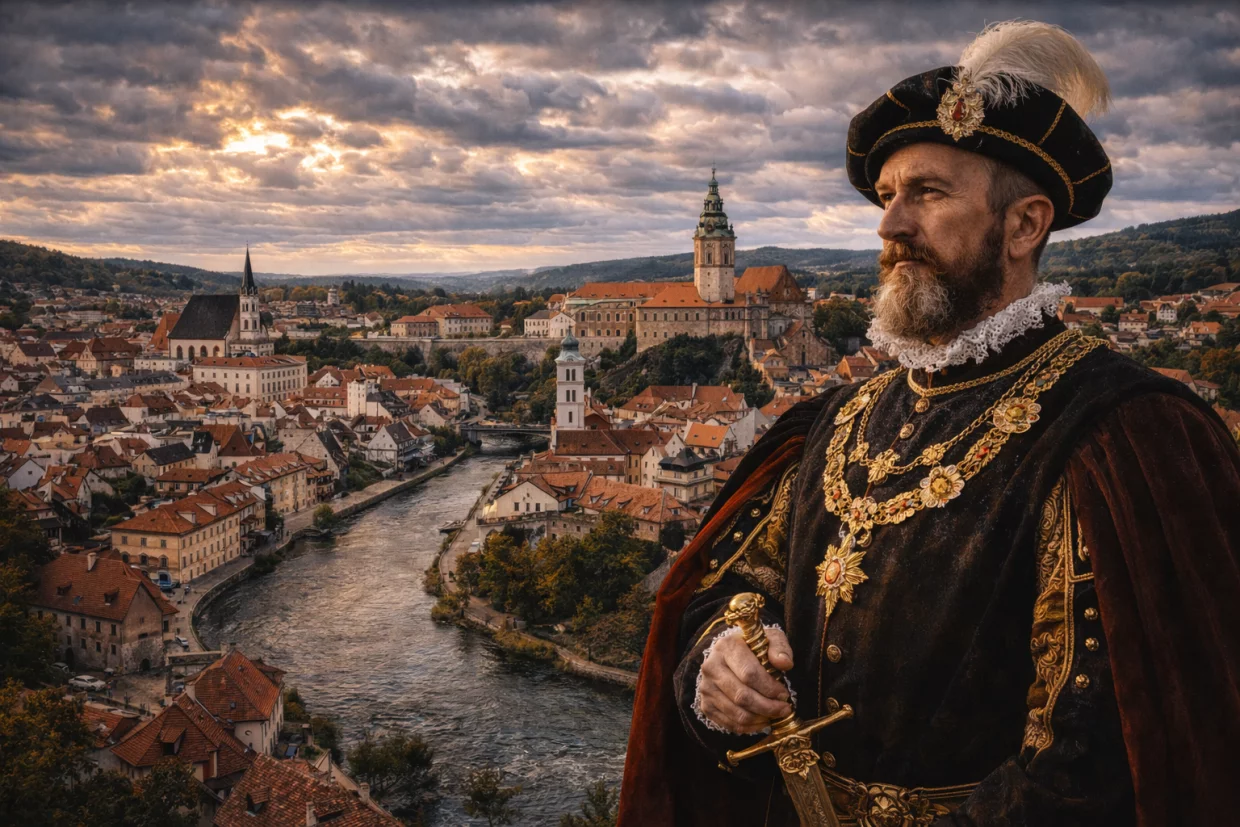
Location and Historical Background
The town lies deep in South Bohemia, wrapped tightly by a dramatic bend of the Vltava River, surrounded by forested hills and gentle countryside. The river doesn’t just pass through — it embraces the town, shaping its streets, fortifications, and destiny. Even today, Český Krumlov feels geographically protected, as if the outside world were optional.
Founded in the 13th century, the town grew beneath its castle as a strategic and economic center controlled first by the powerful Rosenberg family. Legend claims the castle was built where bears once roamed freely — a story the town proudly maintains by keeping bears in the castle moat to this day, just in case anyone forgets.
Three Greatest Blows Český Krumlov Endured
1. The Thirty Years’ War (1618–1648)
Like much of Bohemia, Český Krumlov suffered occupation, looting, and economic collapse during the Thirty Years’ War. The town was occupied by foreign armies, trade declined, and prosperity faded. Though the buildings survived, the spirit of the town was deeply shaken.
2. Decline After the Rosenbergs (17th century)
After the extinction of the Rosenberg family line in 1611, the town lost its most powerful patrons. Under Habsburg rule, Český Krumlov became a provincial backwater. Ironically, this decline spared it from industrialization and radical rebuilding.
3. Communist Neglect (1948–1989)
During the communist era, Český Krumlov was neglected, its historic buildings deteriorating and population shrinking. Investment disappeared, but so did modernization — preserving the town unintentionally for the future.
The Golden Age of Český Krumlov
The town’s golden age came in the 16th century, under the Rosenberg family. Trade flourished, Renaissance architecture reshaped the town, and the castle expanded into one of the largest complexes in Central Europe. Art, culture, and political influence radiated from this small but powerful seat.
Why Český Krumlov Is Worth Visiting Today
Today, Český Krumlov feels like a perfectly preserved stage set — except people live in it. Its UNESCO-listed Old Town invites wandering without direction, while the castle complex offers breathtaking views and layered history.
Despite heavy tourism, quiet moments still exist: early mornings, late evenings, mist over the river. Cultural festivals, galleries, music, and local cuisine keep the town alive beyond its postcard image.
In summary, Český Krumlov is ideal for travelers seeking romance, beauty, and history condensed into walkable perfection.
Tourist Information and Must-See Sights
Estimated Prices (EUR):
- Average lunch in a restaurant: 12–18 €
- Mid-range hotel per night: 90–150 €
- One beer (0.5 l): 2.5–3.5 €
- One coffee: 3–4 €
Most Interesting Areas:
- Old Town
- Castle District
- Riverbanks and bridges
Top 3 Must-Visit Attractions
Český Krumlov Castle
The second-largest castle complex in the Czech Republic. Its courtyards, gardens, Baroque theatre, and panoramic views dominate the town’s identity.
The Old Town
A maze of medieval streets, colorful facades, and hidden courtyards. Best explored slowly, ideally without a map.
The Vltava River Walks
Paths along the river offer calm perspectives of the town’s architecture and reflections. Canoes drifting past complete the scene.
Final Summary
Český Krumlov doesn’t evolve — it endures beautifully. It reminds visitors that sometimes the best future for a place is simply to survive intact. Come for the fairy tale, stay for the silence between the crowds.