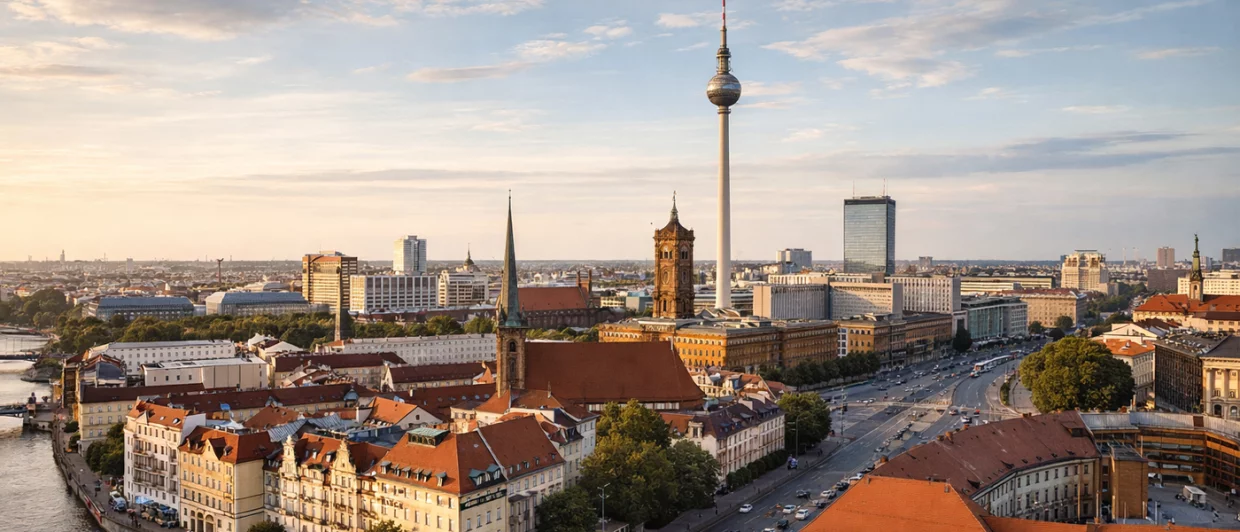
Location and Historical Background
Berlin lies in northeastern Germany on the flat plains of Brandenburg, shaped by the Spree and Havel rivers, lakes, forests, and wide open horizons. The landscape is subtle rather than dramatic, but the city compensates with sheer scale and atmosphere. Today, visitors are struck by Berlin’s contrasts: imperial boulevards, socialist housing blocks, cutting-edge architecture, and vast green spaces existing side by side.
Berlin was first mentioned in 1237, originally as two trading settlements—Berlin and Cölln—on opposite sides of the Spree River. Legend says the city was founded where merchants realized that arguing over tolls was easier if both sides could watch each other across a bridge. Over time, those arguments built a capital.
The Three Greatest Blows to the City
The Thirty Years’ War (1618–1648)
Berlin suffered catastrophic population loss during this brutal conflict. By 1648, the city had lost nearly half of its inhabitants due to warfare, famine, and disease. Economic life collapsed, and Berlin was left weakened and vulnerable for decades.
World War II Destruction (1939–1945)
Between 1943 and 1945, Berlin was heavily bombed by Allied forces. Large parts of the city were reduced to rubble, infrastructure collapsed, and civilian casualties were immense. The war ended not just Berlin’s buildings, but an entire era of German history.
Division and the Berlin Wall (1961–1989)
In 1961, the Berlin Wall physically split the city into East and West. Families were separated, neighborhoods cut in half, and daily life became a geopolitical statement. The Wall’s fall in 1989 was both a liberation and the beginning of a long, painful reunification process.
The Golden Age of Berlin
Berlin’s golden age came in the 1920s, during the Weimar Republic. The city became a global center of art, science, cinema, and nightlife. Intellectual freedom, cultural experimentation, and economic growth turned Berlin into one of the most exciting cities on Earth—until history intervened brutally.
Why Berlin Is Worth Visiting Today
Modern Berlin is a city of layers. Museums, memorials, clubs, parks, and neighborhoods each tell a different story. You can explore Prussian palaces in the morning, Cold War history at noon, street art in the afternoon, and underground music scenes at night. Few cities offer such intellectual and emotional range.
In summary, Berlin is not about sights—it’s about context. Visiting Berlin means understanding Europe’s past, present, and possible future in one endlessly complex city.
Tourist Information and Must-See Sights
Estimated Prices
- Average lunch: €12–16
- Mid-range hotel (per night): €90–150
- One beer (0.5 l): €4–5
- One coffee: €3–4
The most tourist-friendly areas include Mitte, Kreuzberg, Friedrichshain, Prenzlauer Berg, and Charlottenburg.
Must-Visit Places
Brandenburg Gate
The most famous symbol of Berlin, representing division, reunification, and German history in a single structure.
Berlin Wall Memorial
A powerful site preserving the memory of the Wall, offering insight into everyday life during the Cold War.
Museum Island
A UNESCO-listed cluster of world-class museums showcasing art, archaeology, and human history on a grand scale.
Final Summary
Berlin won’t seduce you—it will confront you, confuse you, and probably change your mind about a few things. Come curious, stay open, and leave knowing that some cities aren’t meant to be understood—only experienced.