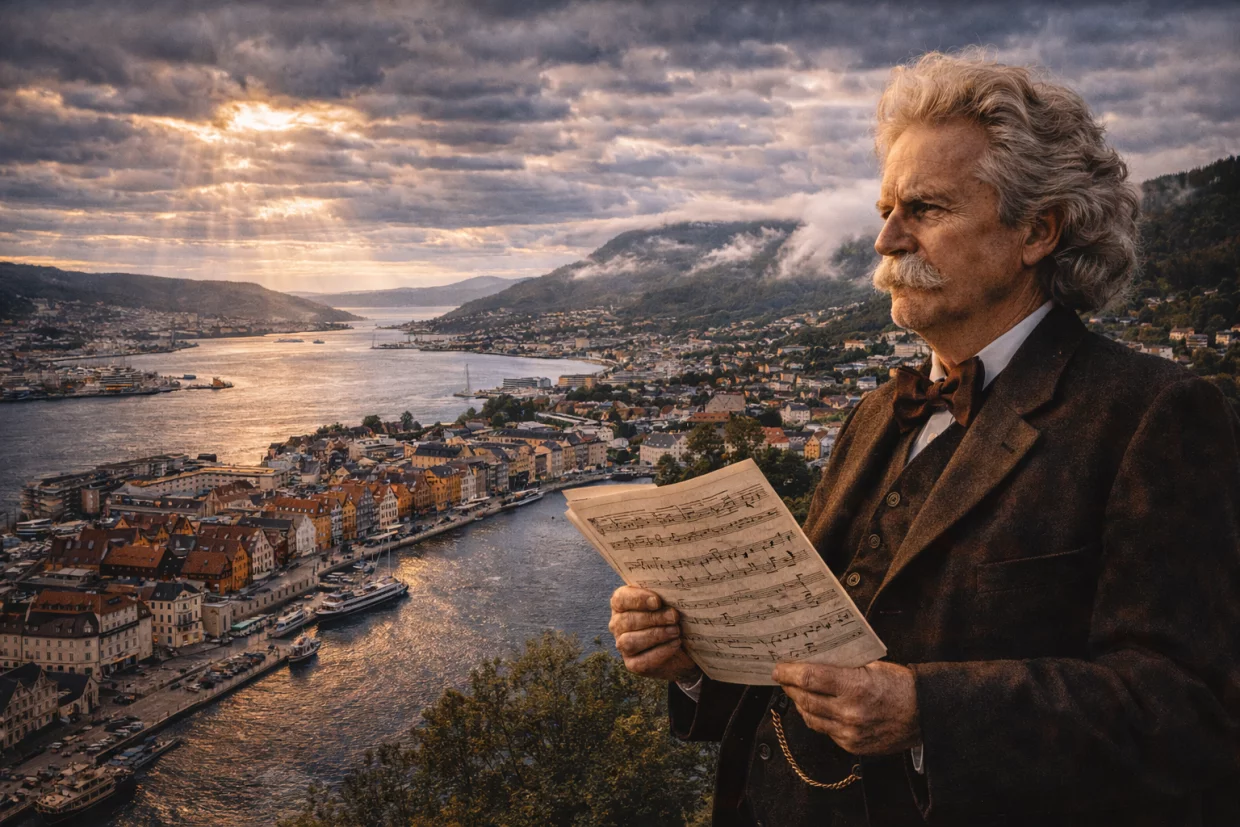
Location and Historical Background
Bergen lies on Norway’s western coast, wedged dramatically between the North Sea and seven steep mountains. Fjords begin almost immediately beyond the city, carving deep into the landscape like natural corridors. Water, rock, and forest dominate everything — Bergen doesn’t sit in nature, it is embedded in it.
Founded in 1070 by King Olaf Kyrre, Bergen quickly became Norway’s main trading hub. Legend claims merchants chose Bergen because ships could hide safely in the harbor while mountains kept watch — a combination that made the city rich, crowded, and cosmopolitan long before Norway itself felt unified.
Three Greatest Blows Bergen Endured
1. Repeated Medieval Fires (12th–18th centuries)
Built largely of wood and packed tightly, Bergen burned again and again. Major fires in 1198, 1248, 1476, and 1702 destroyed large parts of the city. Each time, Bergen rebuilt — stubbornly, often in the same place, refusing to relocate or modernize too quickly.
2. Decline of Hanseatic Power (16th–17th centuries)
As the influence of the Hanseatic League faded and trade routes shifted, Bergen lost its dominant economic role. Power moved east to Oslo, and Bergen transitioned from national capital to regional stronghold.
3. World War II Occupation and Explosions (1940–1944)
During Nazi occupation, Bergen was heavily militarized. In 1944, a Dutch ammunition ship exploded in the harbor, killing hundreds and devastating nearby neighborhoods. It remains one of Norway’s worst wartime disasters.
The Golden Age of Bergen
Bergen’s golden age spanned the 13th to 15th centuries, when it served as Norway’s de facto capital and a major Hanseatic League city. Trade in fish, grain, and goods connected Bergen to all of Northern Europe. German merchants shaped the city’s culture, architecture, and international mindset — influences still visible today.
Why Bergen Is Worth Visiting Today
Today, Bergen is Norway’s cultural counterweight to Oslo. Creative, independent, and proudly regional, it blends history with outdoor life seamlessly. The city is compact, walkable, and dramatically framed by nature.
Visitors explore museums, music venues, and historic districts — then take cable cars or hikes straight into the mountains. Fjords, islands, and coastal villages are day trips, not expeditions.
In summary, Bergen is perfect for travelers who want urban life with immediate wilderness, history with texture, and cities that wear their weather with pride.
Tourist Information and Must-See Sights
Estimated Prices (EUR):
- Average lunch in a restaurant: 18–25 €
- Mid-range hotel per night: 140–220 €
- One beer (0.5 l): 9–11 €
- One coffee: 4.5–6.5 €
Most Interesting Areas:
- Bryggen and the Old Harbor
- City Center and Vågen Bay
- Mountain viewpoints and trails
Top 3 Must-Visit Attractions
Bryggen Wharf
A UNESCO World Heritage Site with iconic wooden Hanseatic houses. Narrow alleys and creaking boards tell stories of trade, fire, and foreign merchants.
Mount Fløyen
Accessible by funicular, offering panoramic views over the city, harbor, and surrounding mountains. One of the best urban viewpoints in Scandinavia.
Fish Market (Fisketorget)
A lively harbor market showcasing Norway’s seafood culture. Touristic but authentic — and delicious.
Final Summary
Bergen doesn’t wait for clear skies — it looks better in clouds. Moody, historic, and magnificently placed, it proves that great cities don’t need perfect weather — just strong character and a good harbor.
Tags: Germany • Netherland • Norway • Scandinavia • War • Weather