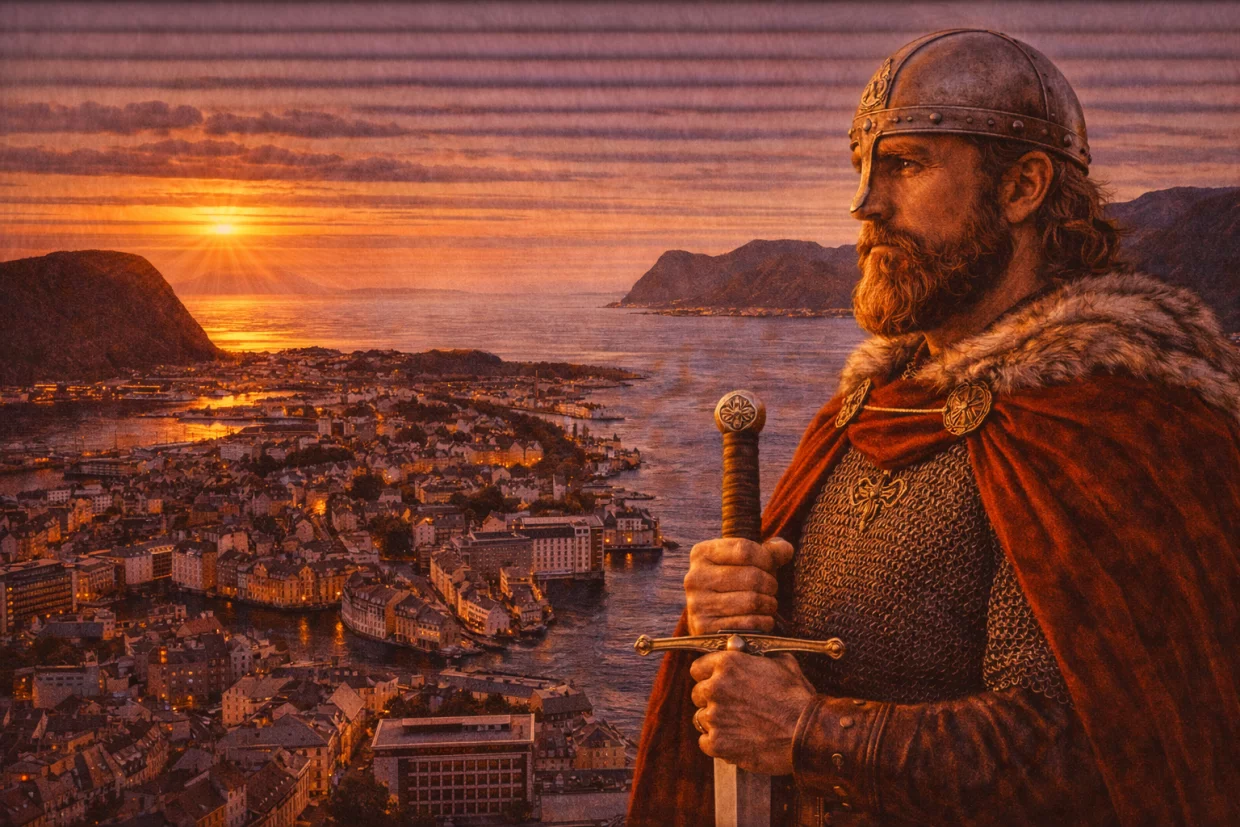
Location and Historical Background
Ålesund lies on Norway’s western coast, spread across several islands at the entrance to the Sunnmøre fjords. The Atlantic breathes directly into the streets, while sharp mountain peaks rise immediately behind the city. Water, wind, and stone dominate the landscape — nature here is never passive.
The settlement began as a fishing harbor in the early Middle Ages, growing slowly through trade and maritime life. Legend says the town always relied on the sea more than land — which explains both its wealth and its vulnerability.
Three Greatest Blows Ålesund Endured
1. The Great Fire of 1904
In January 1904, a devastating fire swept through Ålesund, destroying nearly the entire wooden town in a single night. Over 10,000 residents were left homeless. Miraculously, only one life was lost — but the city itself ceased to exist.
2. Economic Hardship after World War I (1920s)
After rapid reconstruction, Ålesund faced economic instability. Fishing markets fluctuated, global trade slowed, and the ambitious rebuilding effort left financial strain on residents and institutions.
3. Wartime Occupation (1940–1945)
During World War II, Ålesund was occupied by Nazi forces. The harbor and coastline were militarized, restricting trade and daily life in a city that depended entirely on the sea.
The Golden Age of Ålesund
Ålesund’s golden age began after 1904, when the city was rebuilt almost entirely in Art Nouveau (Jugendstil) style. Architects from across Scandinavia created a unified, ornamental cityscape rarely found anywhere else. German Kaiser Wilhelm II provided significant aid — helping turn catastrophe into architectural identity.
Why Ålesund Is Worth Visiting Today
Today, Ålesund feels curated without being artificial. Its streets flow logically, buildings speak the same design language, and viewpoints appear effortlessly. The city is compact, elegant, and surrounded by some of Norway’s most spectacular landscapes.
Visitors use Ålesund as a gateway to fjords like Geirangerfjord, hike nearby mountains, explore islands, or simply enjoy the harmony of the town itself. This is a city best experienced slowly, visually, and repeatedly.
In summary, Ålesund is ideal for travelers who want architecture with narrative, cities reborn rather than inherited, and fjords within arm’s reach.
Tourist Information and Must-See Sights
Estimated Prices (EUR):
- Average lunch in a restaurant: 18–25 €
- Mid-range hotel per night: 140–220 €
- One beer (0.5 l): 9–11 €
- One coffee: 4.5–6.5 €
Most Interesting Areas:
- City Center and Harbor
- Apotekertorget and Jugendstil District
- Viewpoints on surrounding hills
Top 3 Must-Visit Attractions
Jugendstilsenteret (Art Nouveau Centre)
A museum dedicated to the city’s unique architectural rebirth. Essential for understanding why Ålesund looks the way it does.
Mount Aksla Viewpoint
Reached by stairs or road, offering panoramic views over the islands, harbor, and mountains. One of Norway’s most iconic urban vistas.
The Harbor and Brosundet Canal
The heart of the city, where architecture, water, and daily life intersect. Walks here define the Ålesund experience.
Final Summary
Ålesund didn’t plan to be beautiful — it was forced to start over and chose elegance. Rising from ashes with discipline and style, it proves that sometimes destruction clears the way for the most coherent ideas.
Tags: Germany • Norway • Scandinavia • War