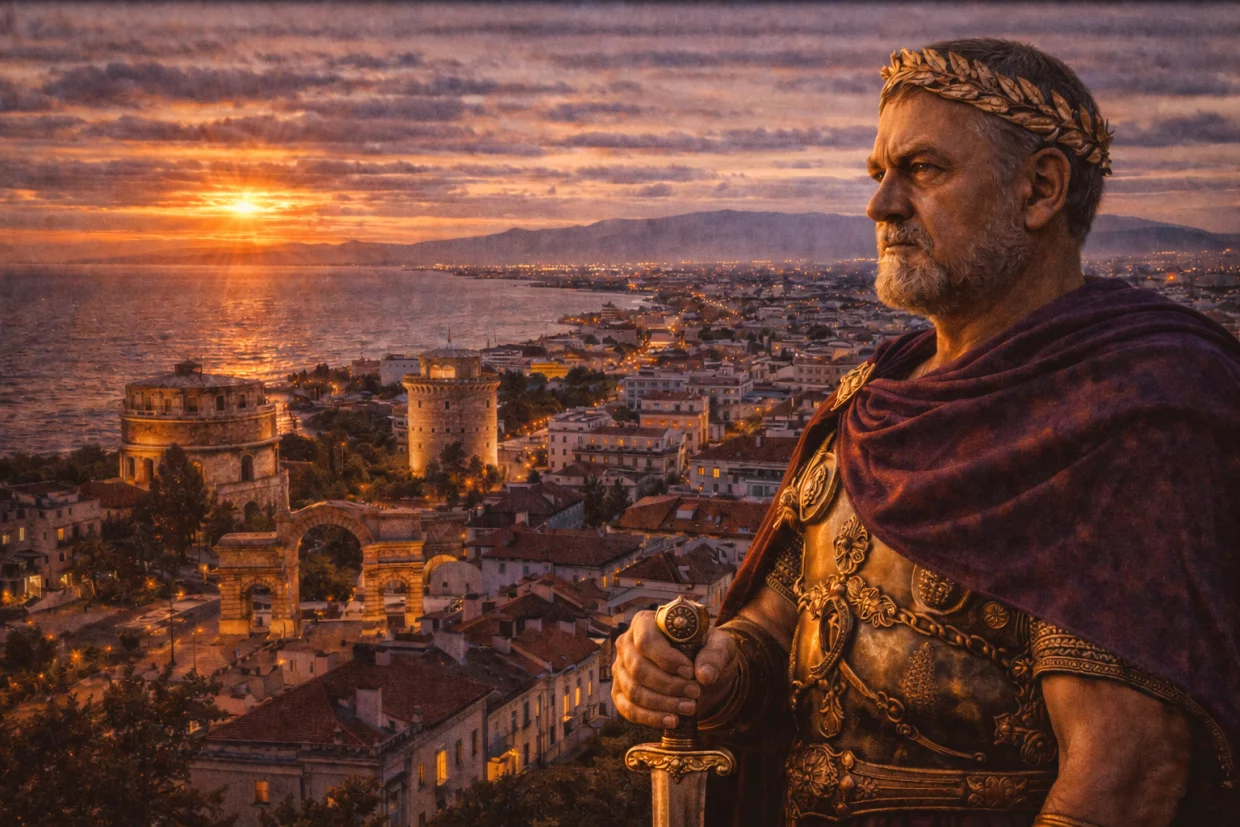
Location and Historical Background
Thessaloniki stretches along the Thermaic Gulf in northern Greece, backed by rolling hills and facing the open waters of the Aegean Sea. Its seaside promenade is one of the longest and liveliest in the Balkans, while Mount Olympus rises in the distance on clear days, quietly reminding everyone who started the mythology business. Today, the city impresses with its youthful energy, food scene, and effortless mix of ancient, Byzantine, and modern life.
Founded in 315 BCE by King Cassander of Macedon and named after his wife Thessalonike (half-sister of Alexander the Great), the city was born ambitious. A local myth claims Thessalonike became a sea nymph after death and still whispers to sailors—an explanation many locals accept without irony.
First great blow – Gothic sack (390 CE):
In 390 CE, Thessaloniki suffered violent upheaval during Roman rule, culminating in massacres and destruction tied to imperial reprisals. The city recovered, but the event left deep scars in its relationship with authority and power.
Second great blow – Ottoman conquest (1430):
After centuries as a major Byzantine stronghold, Thessaloniki fell to the Ottomans in 1430. Large parts of the population were displaced, churches converted, and the city’s Christian dominance ended. Yet under Ottoman rule, Thessaloniki also became a haven for Sephardic Jews expelled from Spain in 1492, reshaping its identity.
Third great blow – Fire of 1917:
One of the most devastating urban disasters in European history struck in 1917, when a massive fire destroyed over two-thirds of the city center. More than 70,000 people were left homeless. While tragic, the fire led to a complete redesign of the modern city.
Golden Age – Roman and Byzantine prosperity (4th–12th centuries):
Thessaloniki’s golden age spanned late Roman and Byzantine times, when it was the empire’s second most important city after Constantinople. Trade, art, theology, and education flourished, leaving behind churches, walls, and ideas that still define the city.
Why Thessaloniki Is Worth Visiting Today
Thessaloniki is one of Europe’s most livable historic cities. It feels young thanks to its massive student population, creative scene, and nightlife that ignores clocks. At the same time, it’s deeply historical—Roman forums, Byzantine churches, Ottoman baths, and Jewish heritage all coexist within walking distance.
What truly makes Thessaloniki special is its personality. This is a city that loves conversation, food, and debate. Visitors don’t feel like outsiders for long; the city absorbs you quickly and insists you stay out late.
Tourist Information and Must-See Places
- Average lunch: €10–14
- Average accommodation (mid-range hotel): €80–120 per night
- One beer: €4–5
- One coffee: €3–4
Most interesting areas:
Waterfront Promenade, Ladadika, Ano Poli (Upper Town)
White Tower
The city’s most famous landmark and symbol. Once a prison and fortress, today it offers panoramic views and a compact introduction to Thessaloniki’s layered history.
Ano Poli (Upper Town)
The only part of the city to survive the 1917 fire. Narrow streets, Ottoman-era houses, city walls, and stunning views make this the most atmospheric neighborhood.
Rotunda of Galerius
Originally built in the 4th century CE, this massive circular structure has served as a Roman monument, church, mosque, and museum—perfectly summarizing the city’s history in one building.
Final Summary
Thessaloniki doesn’t live in the past—it argues with it, flirts with it, and then goes out for drinks. It’s a city where empires came and left, but conversation never stopped. If Athens is Greece’s mind, Thessaloniki is its voice—loud, warm, and impossible to ignore.