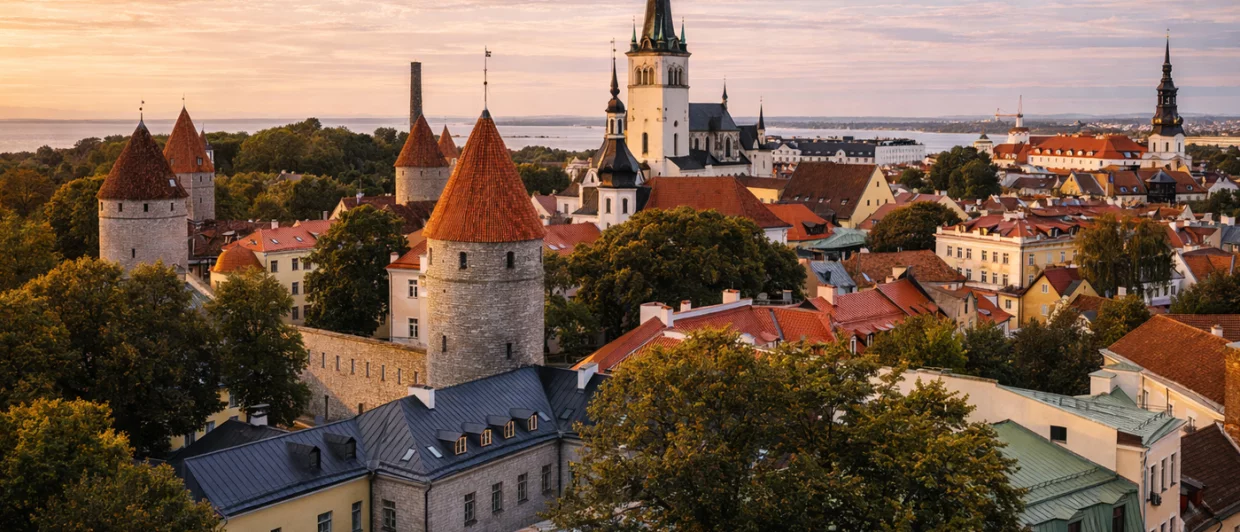
Location and Historical Background
Nestled along the southern coast of the Gulf of Finland, Tallinn rises gently from the Baltic Sea, framed by pine forests, rocky shores, and a natural harbor that has attracted traders, conquerors, and dreamers for over a thousand years. Today, visitors are wowed by the perfectly preserved Old Town skyline, medieval towers, and church spires that seem untouched by time—until you step into a café and pay with your phone in seconds.
Tallinn was first mentioned in 1219, when Danish forces captured the settlement of Lindanise. Legend has it that the Danish flag, the Dannebrog, fell from the sky during this battle—apparently even medieval warfare needed divine branding. Over the centuries, Tallinn (then known as Reval) grew into a vital Hanseatic trading hub linking East and West.
The Three Greatest Blows to the City
The Danish and Teutonic Conquests (13th century)
In 1219, Tallinn fell to the Danes, and by 1346, control passed to the Teutonic Order. While trade flourished, the city endured constant military pressure, shifting rulers, and fortified paranoia. The walls grew higher, towers thicker, and Tallinn learned early how to survive by preparing for the worst.
The Great Northern War (1700–1721)
During this brutal conflict between Sweden and Russia, Tallinn suffered siege, famine, and disease. In 1710, the city surrendered to the Russian Empire after a devastating plague wiped out much of its population. Streets once buzzing with merchants fell silent, and Tallinn entered a long, somber recovery under Russian rule.
World War II and Soviet Occupation (1940–1991)
Tallinn was bombed heavily in March 1944, destroying large parts of the city and killing hundreds. What followed was nearly five decades of Soviet occupation, during which cultural identity was suppressed and historic areas neglected. Yet the Old Town survived—scarred, but standing—waiting patiently for freedom.
The Golden Age of Tallinn
Tallinn’s golden age came during the 14th–16th centuries, when it thrived as a powerful member of the Hanseatic League. Wealth poured in from trade in salt, timber, and grain. Merchant houses rose, guild halls flourished, and the city became one of the richest ports in the Baltic. That medieval prosperity is still visible today in the grand architecture of the Old Town.
Why Tallinn Is Worth Visiting Today
Modern Tallinn is a masterclass in balance. You can walk medieval streets in the morning, visit a cutting-edge tech hub in the afternoon, and relax in a forest park by evening. The city offers culture without crowds, innovation without arrogance, and history without dust. Museums, cafés, seaside promenades, creative districts, and quiet viewpoints all sit within easy walking distance.
In summary, Tallinn feels intimate yet important, ancient yet forward-looking. It doesn’t shout for attention—it simply impresses those who take the time to explore it.
Tourist Information and Must-See Sights
Estimated Prices
- Average lunch: €12–15
- Mid-range hotel (per night): €90–130
- One beer (0.5 l): €5–6
- One coffee: €3–4
The most tourist-friendly areas include the Old Town, Kadriorg, the Seafront, and the creative Telliskivi district.
Must-Visit Places
Tallinn Old Town
A UNESCO-listed masterpiece of medieval urban design, packed with city walls, guild houses, churches, and hidden courtyards. It’s not just pretty—it’s alive.
Toompea Hill
The political and spiritual heart of the city, offering breathtaking views over red rooftops and the Baltic Sea. History feels very close up here.
Kadriorg Park
A graceful green escape built by Peter the Great in the early 18th century, home to palaces, museums, and peaceful walking paths.
Final Summary
Tallinn is proof that you can be medieval without being outdated, digital without being cold, and small without being insignificant. It doesn’t try to impress you—it just quietly succeeds, then offers you a coffee and very fast internet.
Tags: Denmark • Estonia • Finland • Russia • Scandinavia • Sweden • War