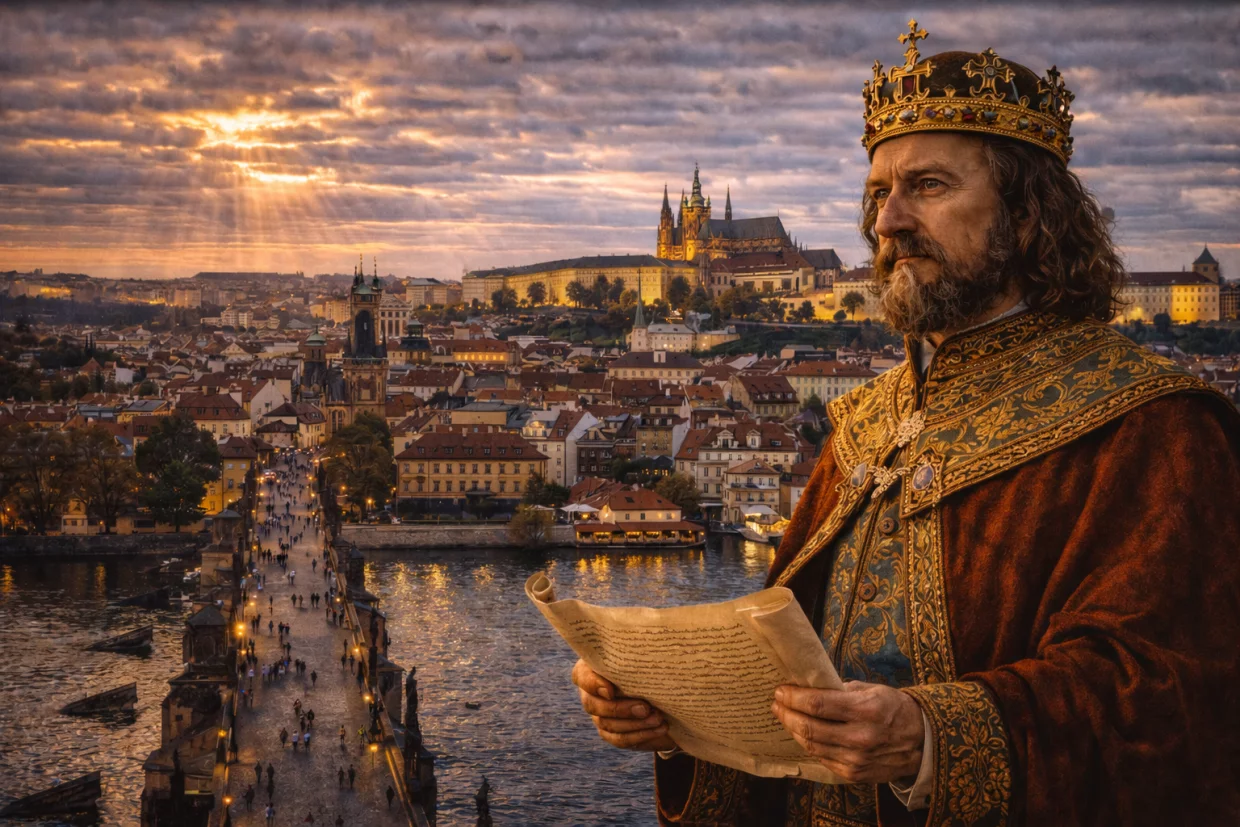
Location and Historical Background
Prague is built along the winding Vltava River, spread across rolling hills that create natural viewpoints, dramatic bridges, and a skyline punctuated by spires rather than skyscrapers. Forests, vineyards, and river valleys surround the city, giving it a softness rarely found in European capitals.
Founded in the early Middle Ages, Prague quickly became the political and cultural heart of Bohemia. Legend claims Princess Libuše foresaw a great city “whose glory would touch the stars.” Whether prophecy or marketing genius, Prague delivered. By the 14th century, under Emperor Charles IV, it became one of Europe’s most important capitals.
Three Greatest Blows Prague Endured
1. The Hussite Wars (1419–1434)
Religious conflict tore Prague apart after the execution of reformer Jan Hus. Uprisings, sieges, and internal violence transformed the city into a battlefield of ideology. Yet Prague emerged as a symbol of religious defiance and intellectual independence.
2. The Thirty Years’ War and the 1648 Siege
The war that began with the famous Defenestration of Prague devastated Central Europe. In 1648, Swedish forces besieged the city, looting art and treasures. Despite destruction and loss, Prague’s core survived largely intact — a rare miracle for a European capital.
3. Nazi Occupation and Communist Rule (1939–1989)
Prague endured occupation by Nazi Germany, followed by four decades of communist control. Intellectual freedom was suppressed, lives were broken, yet the city’s physical fabric remained untouched — history was scarred, but not erased.
The Golden Age of Prague
Prague’s golden age unfolded during the 14th century, when Charles IV ruled as Holy Roman Emperor. Universities, bridges, cathedrals, and fortifications were built, turning Prague into a political, cultural, and spiritual center of Europe. This era shaped the city’s enduring grandeur.
Why Prague Is Worth Visiting Today
Today, Prague offers a rare combination: visual perfection and emotional depth. Visitors can wander medieval streets, attend world-class concerts, drink beer where writers plotted revolutions, and cross bridges unchanged for centuries.
Beyond the postcard landmarks lies a living city — neighborhoods full of cafés, galleries, parks, and local life. Prague rewards both first-time visitors and repeat wanderers, each discovering different layers.
In summary, Prague is not just a destination — it is a reference point for what a European city can be.
Tourist Information and Must-See Sights
Estimated Prices (EUR):
- Average lunch in a restaurant: 10–15 €
- Mid-range hotel per night: 80–130 €
- One beer (0.5 l): 2–3 €
- One coffee: 2.5–4 €
Most Interesting Areas:
- Old Town (Staré Město)
- Lesser Town (Malá Strana)
- Vinohrady and Letná
Top 3 Must-Visit Attractions
Prague Castle
The largest ancient castle complex in the world. A symbol of Czech statehood offering palaces, cathedrals, courtyards, and panoramic views across the city.
Charles Bridge
Completed in the 15th century, this stone bridge is both a historic artery and a living gallery. Cross it early morning or late evening to feel its true power.
Old Town Square
A theatrical space surrounded by Gothic, baroque, and Renaissance architecture. The Astronomical Clock continues to measure time the old-fashioned way — publicly and unapologetically.
Final Summary
Prague doesn’t age — it accumulates. Every century left something behind and politely stepped aside. Visit once for the beauty, return for the atmosphere, and stay because some cities don’t let go easily.
Tags: Czechia • Germany • Scandinavia • Sweden • War