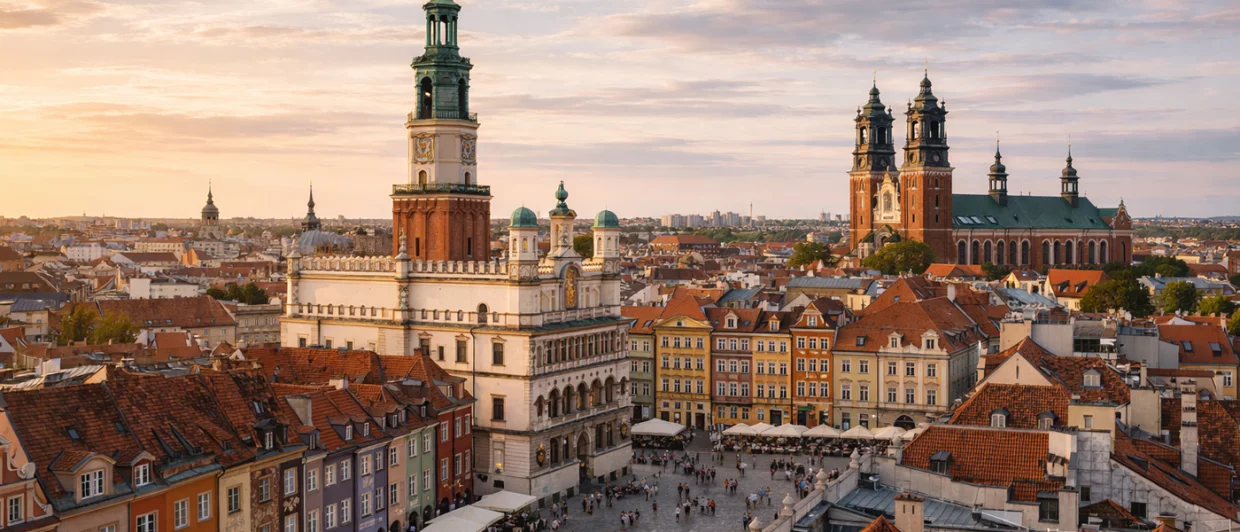
Location & Historical Background
Romantic Setting
Poznań sits on the Warta River amid gentle plains and lakes of western Poland, a landscape more subtle than dramatic—but deeply grounding. Today, visitors are charmed by the colorful Old Market Square, leafy riverside paths, and a city rhythm that feels efficient yet surprisingly warm.
Origins & Foundation
Poznań’s story begins early—very early. The settlement rose in the 10th century, becoming one of the first centers of the emerging Polish state. Legend claims the city was founded where trade routes crossed and tempers flared, forcing merchants to settle disputes permanently—thus inventing both Poznań and Polish negotiation skills.
The Three Greatest Blows
The Swedish Deluge (1655)
In 1655, Swedish armies occupied Poznań during the devastating invasion known as the Deluge. The city was looted, trade collapsed, and population numbers fell sharply, pushing Poznań into a long economic stagnation.
Prussian Annexation (1793)
Following the Second Partition of Poland in 1793, Poznań fell under Prussian rule. Germanization policies, military fortifications, and political repression reshaped the city, challenging Polish identity for over a century.
World War II Destruction (1945)
In 1945, Poznań became a battlefield during the Soviet assault on the German-held city. Intense fighting damaged large areas, especially the historic center, and civilian losses were heavy. Post-war reconstruction restored much—but scars remained.
The Golden Age
Poznań’s golden age came in the 10th–11th centuries, when it served as one of the main capitals of the early Polish state. As a royal and ecclesiastical center, it flourished through trade, craftsmanship, and political importance—foundations that still define its character today.
Why Visit the City Today
Modern Poznań is a city of balance: historic but forward-looking, proud yet approachable. It hosts major international trade fairs, a large student population, vibrant food culture, and efficient public transport. Add nearby lakes, cultural festivals, and a walkable center, and Poznań becomes an easy city to enjoy—and hard to forget.
Tourist Information & Must-See Places
Practical Information (Estimated Averages)
- Average lunch: €8–12
- Average accommodation (per night): €70–120
- One beer: €2.50–3.50
- One coffee: €2–3
Most Interesting Parts of the City
Old Market Square (Stary Rynek), Cathedral Island (Ostrów Tumski), Jeżyce district, and the riverside areas along the Warta.
Top 3 Must-See Attractions
Old Market Square & Town Hall
The colorful heart of the city, famous for its Renaissance town hall and the mechanical goats that butt heads daily at noon—Poznań’s most beloved tradition.
Cathedral Island (Ostrów Tumski)
The oldest part of the city and spiritual birthplace of Poland, home to the cathedral where the first Polish rulers are believed to be buried.
Imperial Castle (Zamek Cesarski)
A monumental symbol of Poznań’s Prussian past, later reclaimed by Polish culture and now serving as a major cultural and exhibition center.
Final Summary
Poznań won’t overwhelm you—it will convince you. With history older than the country itself and a modern mindset to match, this is a city that proves efficiency can still have soul.
Tags: Poland • Scandinavia • Sweden