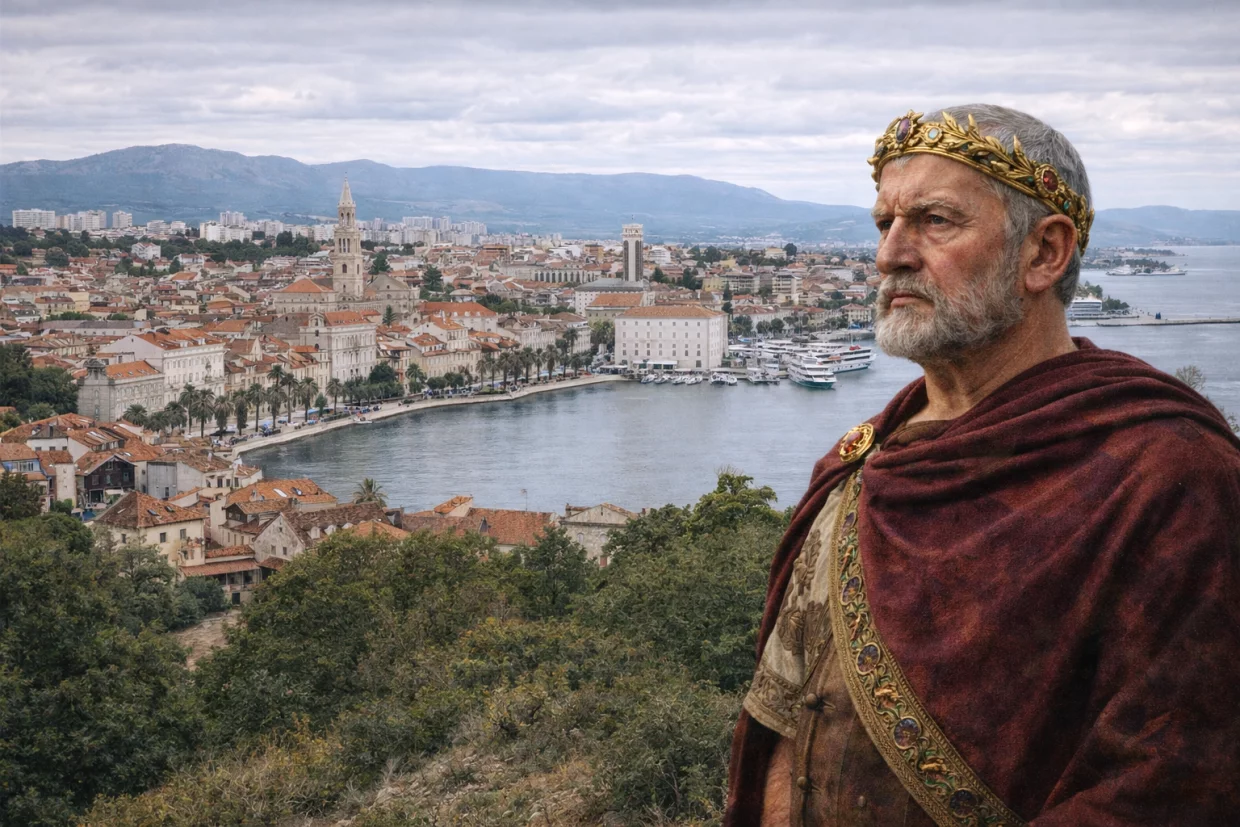
Location and Historical Background
Split lies on the central Dalmatian coast of Croatia, embraced by the sparkling Adriatic Sea on one side and guarded by the mountains of Mosor and Kozjak on the other. Palm-lined promenades, islands scattered on the horizon, and limestone hills give Split a setting that feels effortlessly Mediterranean.
The story of Split begins around the year 305 AD, when the Roman emperor Diocletian chose this location to build a retirement palace. Legend has it that Diocletian, tired of ruling an empire, preferred growing cabbages by the sea. After his death, the palace did not fade into ruin—it slowly transformed into a city as people moved inside its massive walls for protection.
The First Great Blow – The Fall of Salona (7th Century)
In the early 600s, the nearby Roman city of Salona was destroyed during invasions by Avars and Slavs. Refugees fled to Diocletian’s Palace, turning it into a fortified refuge. While tragic, this event unintentionally gave birth to modern Split as a living urban settlement within Roman walls.
The Second Great Blow – Venetian Domination (1420–1797)
For nearly four centuries, Split was ruled by Venice. While trade flourished, political freedom did not. Venetian control shaped architecture and culture but restricted autonomy, leaving the city wealthy yet constrained—an elegant port city with limited self-rule.
The Third Great Blow – World War II Bombings (1943–1944)
During World War II, Split suffered heavy Allied bombings while under Italian and later German control. Large parts of the city were damaged, and civilian casualties were significant. Post-war reconstruction reshaped neighborhoods and accelerated Split’s transformation into a modern urban center.
The Golden Age of Split
Split’s golden age began in the Roman era and returned in the 19th century, when it became a key Dalmatian port under Austro-Hungarian rule. Trade, shipbuilding, and administration fueled growth, while the palace-city hybrid ensured Split remained unique in the Mediterranean world.
Why Split Is Worth Visiting Today
Today, Split is vibrant, loud, relaxed, and unapologetically alive. The Old Town is not just for tourists—it is the city’s heart, filled with local life, spontaneous music, and late-night conversations. Beaches are minutes away, ferries connect nearby islands, and mountains loom close enough for day hikes.
Split also gained global recognition as a filming location for Game of Thrones, but its appeal goes far beyond the screen. Food culture thrives, nightlife is legendary, and the rhythm of the city encourages visitors to slow down and stay a little longer.
In short, Split offers the rare combination of ancient grandeur and modern Mediterranean energy—without ever feeling staged.
Tourist Information and Must-See Sights
- Average lunch: €12–18
- Average accommodation (mid-range hotel): €100–160 per night
- Beer (0.5 l): €5–6
- Coffee: €2.50–3.50
Most interesting areas: Diocletian’s Palace, Riva Promenade, Bačvice, Marjan Hill.
Diocletian's Palace
The core of the city and a UNESCO World Heritage Site. Unlike any other Roman ruin, this palace is fully inhabited, blending antiquity with everyday life in a way found nowhere else.
Riva Promenade
Split’s living room by the sea. Palm trees, cafés, and endless people-watching make it the perfect place to understand the city’s soul.
Marjan Hill
A green oasis rising above the city, offering panoramic views, walking trails, and a peaceful escape just minutes from the Old Town.
Final Summary
Split is proof that history does not have to be quiet. It laughs, drinks coffee, argues loudly, and lives inside a Roman palace without apology. If Rome built monuments, Split moved into one—and turned it into a lifestyle.
Tags: Croatia • Germany • Italy • Mediterranean • War