Location and Historical Background
Mikulov lies in South Moravia, nestled between rolling vineyards and the limestone hills of the Pálava region, just a few kilometers from the Austrian border. The landscape is warm, open, and Mediterranean by Central European standards. Vineyards climb slopes, sunlight lingers longer, and the town seems permanently relaxed by its surroundings.
First mentioned in the 11th century, Mikulov developed as a strategic border settlement and later as a noble residence. Legend claims the town’s location was chosen because grapes grew better here than worries — a theory still supported by local winemakers. Over time, Mikulov became a center of trade, culture, and wine production.
Three Greatest Blows Mikulov Endured
1. The Thirty Years’ War and Swedish Occupation (1645)
During the Thirty Years’ War, Mikulov was occupied by Swedish forces. The town suffered looting, destruction, and economic hardship. Many buildings were damaged, and recovery took decades.
2. Devastating Fires (1719 and 1737)
Two major fires nearly destroyed Mikulov, including large parts of the château and town center. These disasters reshaped the town’s architecture, leading to Baroque rebuilding that still defines its appearance.
3. World War II and Post-War Expulsions (1945)
Mikulov’s long-established German-speaking population was expelled after World War II. This abrupt demographic change broke cultural continuity and left the town socially and economically weakened for years.
The Golden Age of Mikulov
Mikulov’s golden age came between the 16th and 18th centuries, under the Liechtenstein family. The château expanded into a grand Baroque residence, vineyards flourished, and Mikulov became an intellectual and cultural center — including one of Central Europe’s most important Jewish communities.
Why Mikulov Is Worth Visiting Today
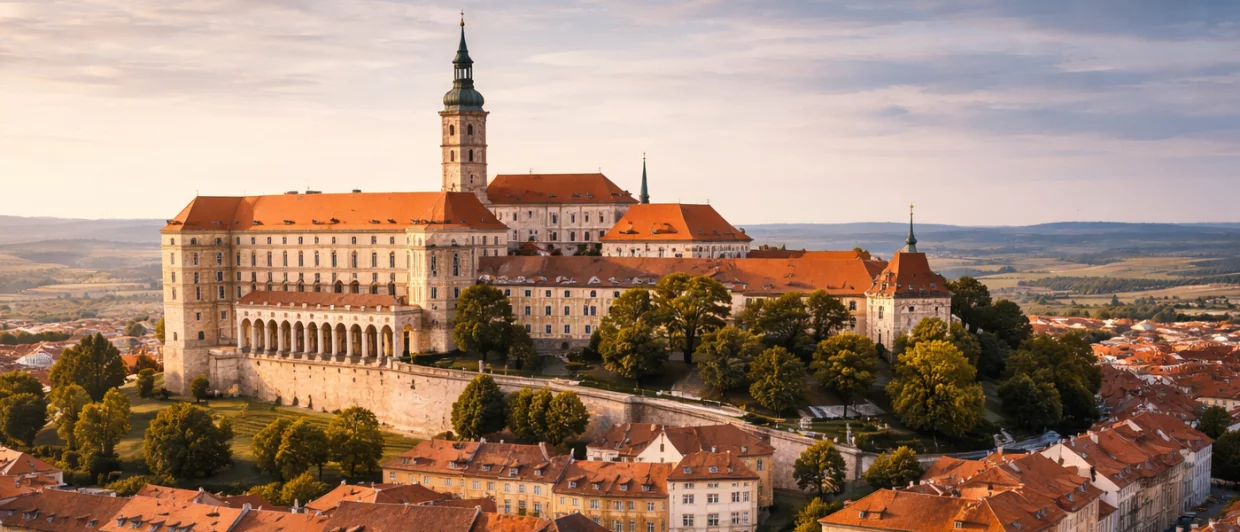
Today, Mikulov is one of the Czech Republic’s most atmospheric towns. Its skyline — château, Holy Hill, and church towers — is instantly recognizable. Wine cellars, tasting rooms, and festivals define the social calendar, while cycling paths connect the town to vineyards, villages, and nature reserves.
Visitors enjoy compact walkability, excellent gastronomy, and sunsets that feel staged. Mikulov doesn’t separate nature from culture — it ferments them together.
In summary, Mikulov is perfect for travelers who want history with warmth, wine with context, and beauty without pretense.
Tourist Information and Must-See Sights
Estimated Prices (EUR):
- Average lunch in a restaurant: 11–16 €
- Mid-range hotel or guesthouse per night: 85–140 €
- One beer (0.5 l): 2.5–3.5 €
- One coffee: 3–4 €
- Wine tasting (glass): 2–4 €
Most Interesting Areas:
- Historic Town Center
- Château Hill
- Vineyard slopes around the town
Top 3 Must-Visit Attractions
Mikulov Château
Dominating the town from above, this Baroque château houses regional museums and offers panoramic views over vineyards and rooftops. It defines Mikulov’s identity.
Holy Hill (Svatý kopeček)
A pilgrimage hill crowned by a chapel, offering one of the best views in South Moravia. Sunset here is practically a local religion.
The Jewish Quarter and Cemetery
One of the most important Jewish heritage sites in the Czech Republic. Quiet, powerful, and deeply historical, it reflects Mikulov’s multicultural past.
Final Summary
Mikulov doesn’t rush maturation — it understands fermentation. History, wine, and sunlight have been given enough time here, and the result is a town best enjoyed slowly, thoughtfully, and preferably with a full glass.
Tags: Austria • Czechia • Mediterranean • Moravia • Scandinavia • Sweden • War