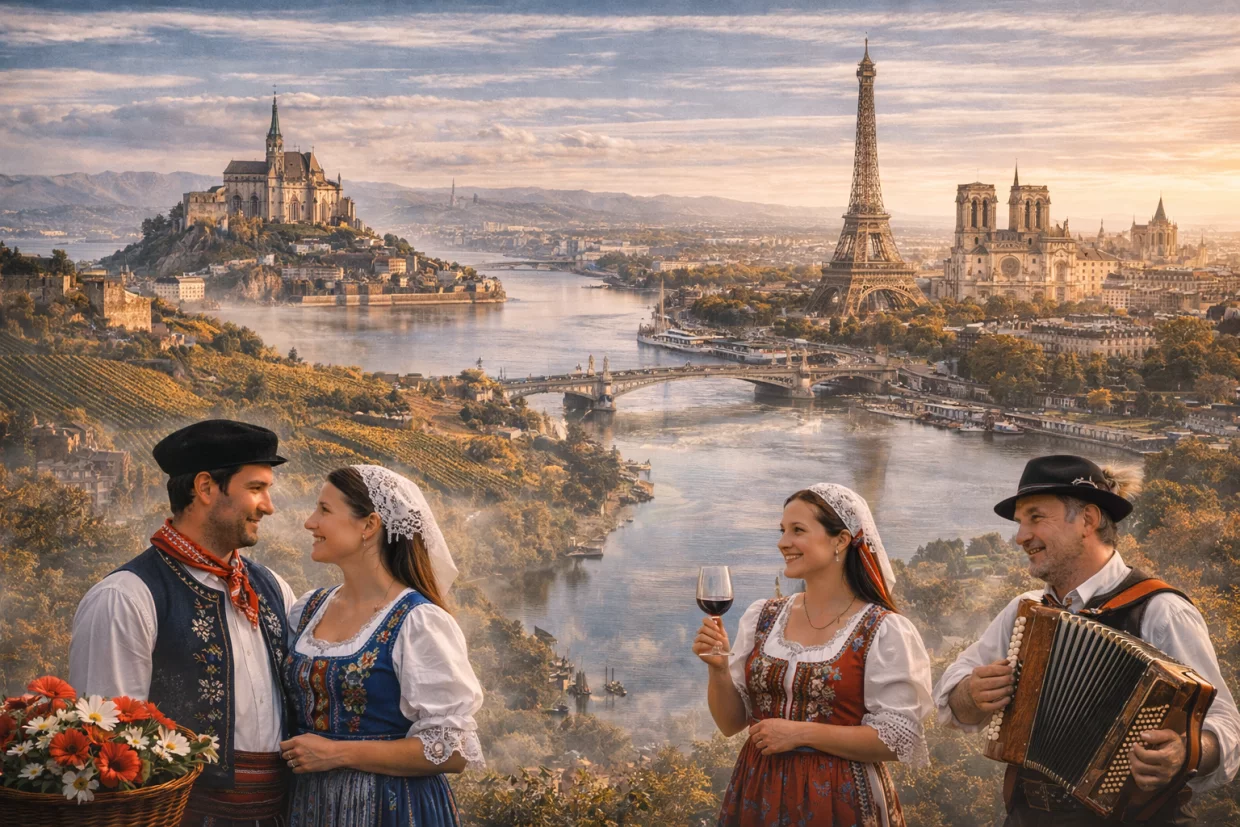
What’s the problem right now?
France sees itself as a leader.
Europe often sees France as… intense.
It has:
- strong political tradition
- global diplomatic reach
- military capability
- cultural confidence
But also:
- chronic social tension
- frequent protests
- centralized power
- difficulty turning vision into durable results
France doesn’t lack ambition. It struggles with execution and acceptance.
Where Germany hesitates, France pushes. Where Europe negotiates, France declares.
How history taught France to trust ideas — and challenge authority
France’s identity is built on the belief that ideas matter.
The Enlightenment wasn’t just a chapter — it was a mindset.
Thinkers like Jean-Jacques Rousseau framed politics as a moral project, not just administration.
Then came the Revolution.
France learned two lessons at once:
Authority can be overthrown. Chaos can be productive.
From Napoleon Bonaparte onward, France became comfortable with strong leadership — as long as it claimed to represent a higher ideal.
Later, figures like Charles de Gaulle reinforced the belief that:
France doesn’t follow history — it corrects it.
This produced a country deeply confident in its intellectual direction — and permanently suspicious of compromise.
Centralization, pride, and impatience
France believes in the state.
Not as a burden — but as an instrument of purpose.
Power is centralized.
Institutions are strong.
Debate is loud.
But this creates limits:
- reforms come top-down
- resistance comes bottom-up
- trust erodes quickly
French society expects transformation — and protests when it arrives.
Leaders like Emmanuel Macron embody this contradiction:
- visionary
- pro-European
- reform-driven
Yet often perceived as distant, technocratic, and impatient with dissent.
France wants movement. Its people want meaning and protection.
The limits of leading by declaration
France excels at:
- framing big questions
- proposing bold reforms
- setting agendas
It struggles with:
- long-term social buy-in
- incremental compromise
- administrative patience
In Europe, leadership requires listening.
France prefers speaking.
Vision without consensus becomes noise.
Energy without coordination becomes friction.
What could realistically help?
Option 1: Treat compromise as strategy, not weakness
Compromise doesn’t dilute ideas — it gives them longevity.
Pros: influence, stability
Cons: slower progress, less drama
Option 2: Decentralize trust, not just administration
France doesn’t need less state.
It needs more shared ownership.
Pros: legitimacy, resilience
Cons: loss of control
Option 3: Lead Europe with Germany — not ahead of it
When France and Germany align, Europe moves.
When they don’t, Europe debates.
Final thought
France gives Europe its direction. Germany gives it stability.
Europe works best when France remembers that ideas need patience — and when others remember that without ideas, patience goes nowhere.
Tags: Germany