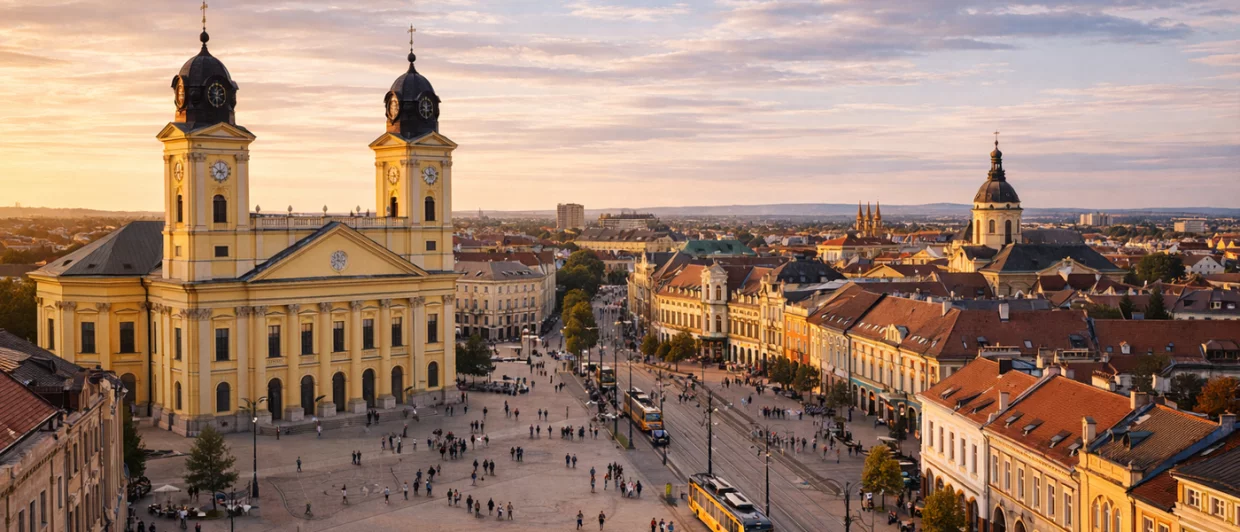
Location & Historical Background
Romantic Setting
Debrecen rises from the vast openness of the Great Hungarian Plain, where the horizon feels endless and the sky plays a daily theatre of light. Today, visitors are surprised by how green and spacious the city feels, with wide boulevards, parks, and a calm rhythm that contrasts beautifully with its cultural intensity.
Origins & Foundation
The first written mention of Debrecen dates to 1235, though folklore claims the town grew from a humble crossroads where traders argued so loudly that a settlement naturally formed around the noise. Its location made it a natural market town, and Debrecen quickly developed a reputation for independence and self-rule.
The Three Greatest Blows
The Mongol Invasion (1241–1242)
During the Mongol invasion of 1241, the region around Debrecen was devastated. Although the settlement survived due to its dispersed structure, population losses were severe, and rebuilding took decades.
Fire of 1802
In 1802, a catastrophic fire destroyed much of Debrecen’s wooden buildings, including churches and homes. The disaster reshaped the city entirely, leading to stone construction and the wide streets that define Debrecen today.
World War II Bombings (1944)
As a strategic transport and administrative center, Debrecen suffered heavy bombings in 1944. Large parts of the city were damaged, and thousands were displaced. The post-war reconstruction fundamentally altered the urban landscape.
The Golden Age
Debrecen’s golden age arrived in the 16th and 17th centuries, when it became the intellectual and spiritual heart of Hungarian Calvinism. Prosperity came through trade, education, and religious autonomy, culminating in institutions like the Reformed College, which shaped generations of Hungarian thinkers.
Why Visit the City Today
Today, Debrecen is youthful, cultural, and quietly confident. With a strong university presence, thermal baths, festivals, and one of Hungary’s largest parks, the city offers a balanced mix of relaxation and intellectual energy. It is a place where cafés double as debating halls and history feels actively lived rather than displayed behind glass.
Tourist Information & Must-See Places
Practical Information (Estimated Averages)
- Average lunch: €8–12
- Average accommodation (per night): €70–120
- One beer: €2–3
- One coffee: €1.80–2.50
Most Interesting Parts of the City
Kossuth Square, the historic city center, Nagyerdő (Great Forest) district, and the university quarter.
Top 3 Must-See Attractions
Great Reformed Church
The symbol of Debrecen and Hungarian Protestantism, this monumental church hosted key moments of national history, including the declaration of independence in 1849.
Nagyerdő Park and Thermal Baths
A vast green area combining nature, architecture, and wellness. The modern spa complex makes it a favorite for both locals and visitors.
Reformed College of Debrecen
One of Hungary’s most important educational institutions, showcasing centuries of scholarship, manuscripts, and the intellectual backbone of the city.
Final Summary
Debrecen doesn’t flirt—it lectures, inspires, and then invites you for a beer. Come curious, leave enlightened, and don’t be surprised if the city quietly changes how you think about Hungary.
Tags: Hungary