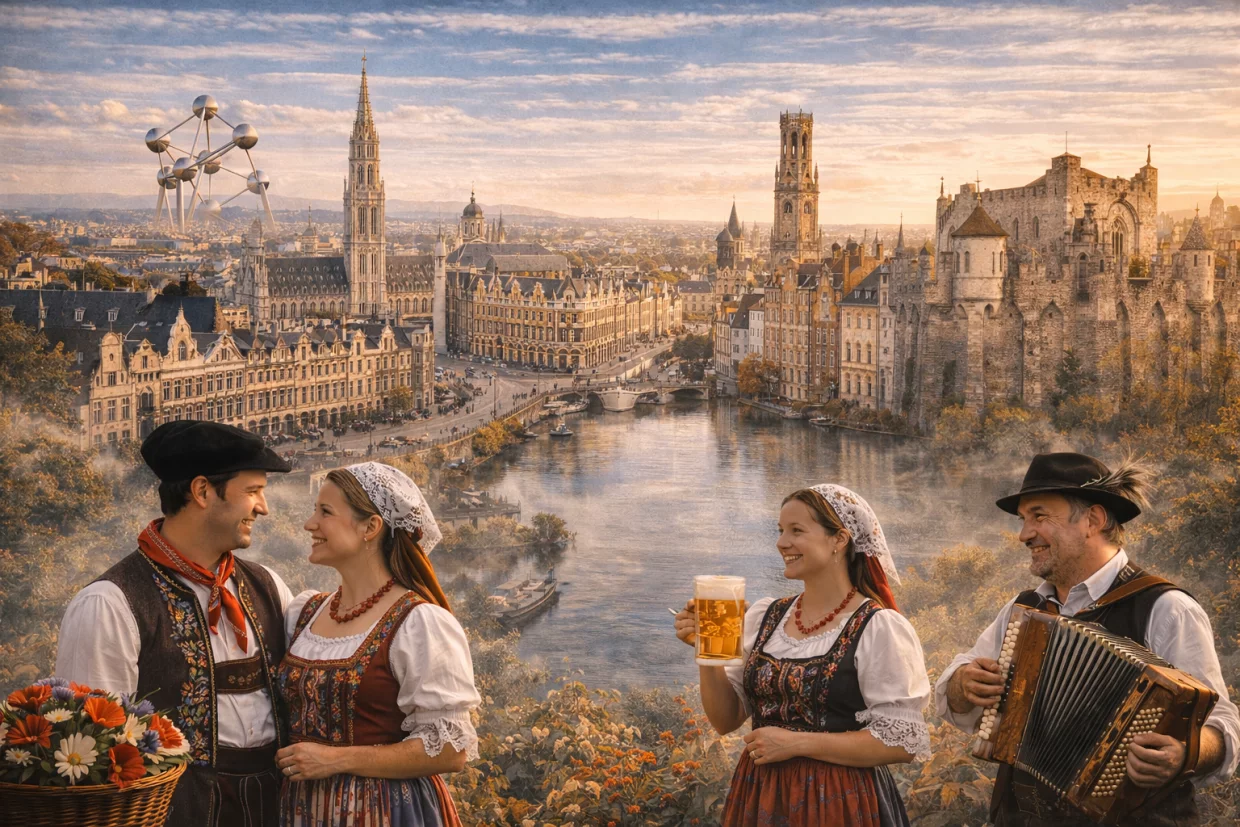
What’s the problem right now?
Belgium functions — often against all expectations.
It has:
- high living standards
- strong social systems
- a central role in European institutions
- relative political stability
But also:
- deep internal division
- complex governance
- slow decision-making
- governments that take longer to form than some wars
Belgium isn’t dysfunctional.
It is permanently negotiating itself.
The country doesn’t ask what is best.
It asks what is acceptable.
How history taught Belgium to survive through balance
Belgium was born as a compromise.
Created in 1830, it was designed to exist — not to lead.
A buffer state between powers, neutral by intention, fragile by design.
Even its monarchy was a balancing tool.
Figures like Leopold II expanded Belgian influence abroad — disastrously so — while internal unity remained delicate.
Later, linguistic and cultural differences hardened:
- Dutch-speaking Flanders
- French-speaking Wallonia
- bilingual Brussels
Instead of forcing unity, Belgium chose coexistence.
The lesson learned:
Survival depends on accommodation, not dominance.
A system built to avoid breaking
Belgium doesn’t centralize power.
It distributes it — carefully, deliberately, endlessly.
Strengths:
- social peace
- protection of minorities
- institutional resilience
Limits:
- administrative complexity
- diluted responsibility
- slow reform
Politics is less about winning and more about not losing too much.
Governments form after long negotiations.
Sometimes very long.
And yet, daily life continues almost unaffected — a quiet achievement few countries could replicate.
Brussels: the irony at the center
Belgium hosts Europe — literally.
Brussels became the heart of the EU not because Belgium demanded it, but because it felt safe.
Not threatening.
Not dominant.
Acceptable to everyone.
Belgium understands Europe because it is Europe in miniature:
- multiple identities
- shared space
- constant compromise
The country that struggles to agree with itself
hosts institutions that struggle to unite a continent.
There is poetry in that.
The limits of eternal compromise
Compromise prevents collapse.
It also prevents momentum.
Belgium’s challenges:
- unclear accountability
- reform fatigue
- political detachment
- difficulty addressing long-term issues decisively
When everyone has a veto, initiative weakens.
Belgium doesn’t fail loudly.
It succeeds quietly — and slowly.
What could realistically help?
Option 1: Simplify without centralizing
Complexity protects balance — but excess complexity protects inertia.
Pros: efficiency
Cons: political resistance
Option 2: Redefine unity as cooperation, not identity
Belgium doesn’t need a shared soul.
It needs shared outcomes.
Pros: realism
Cons: emotional emptiness
Option 3: Embrace its role as Europe’s laboratory
Belgium already tests what Europe debates.
Leaning into that role could turn weakness into influence.
Final thought
Belgium proves that Europe doesn’t need unity to function — only tolerance, patience, and endurance.
Its challenge is learning when compromise sustains peace — and when it quietly replaces ambition.
In a continent built on disagreement, Belgium remains its most honest mirror.
Tags: