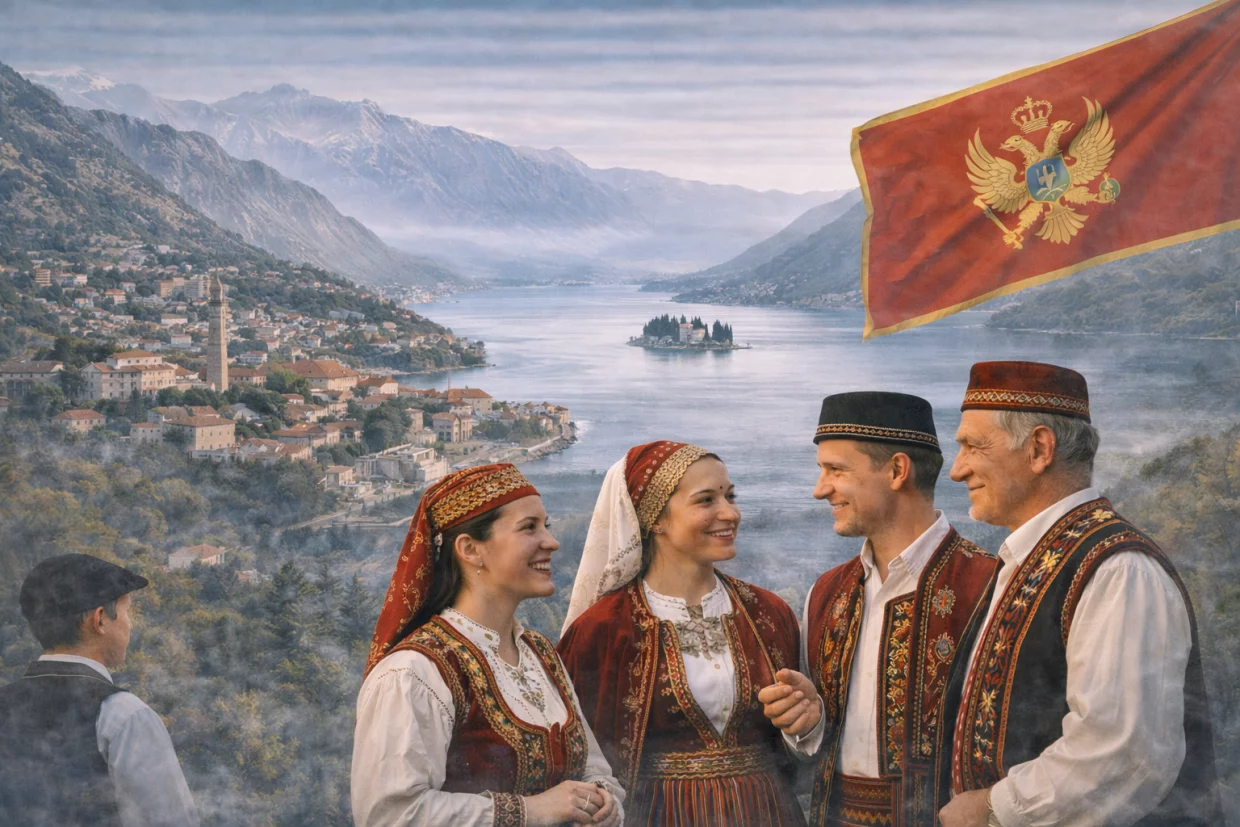
What’s the problem right now?
Montenegro is independent, stable, and slightly unsure.
It has:
- NATO membership
- EU candidate status
- political continuity
- high international visibility relative to size
But also:
- deep political polarization
- weak institutions
- economic dependence on tourism and foreign capital
- identity tensions that never fully resolved
Montenegro isn’t collapsing. It is unfinished.
The state exists. The system is still deciding how autonomous it really wants to be.
How history taught Montenegro to survive by resisting — and adapting
Montenegro’s historical identity is built on defiance.
Unlike many neighbors, it was never fully conquered by the Ottomans.
Survival in the mountains became mythology — and strategy.
The lesson absorbed early:
Freedom is defended, not administered.
For centuries, Montenegro existed as a warrior society more than a bureaucratic one.
Institutions were secondary to loyalty and honor.
Later, Yugoslavia offered safety through scale.
Montenegro adapted again — smaller partner, less spotlight.
Independence in 2006 came peacefully, but ambiguously.
Not through rupture — through separation by referendum.
That left a question open:
Was independence a destination — or just an exit?
Power, personality, and prolonged transition
Modern Montenegro has been shaped heavily by long-term leadership.
Figures like Milo Đukanović didn’t just govern — they defined the system.
Stability came through continuity.
Continuity came at the cost of institutional depth.
Strengths:
- geopolitical pragmatism
- ability to shift alliances
- national branding
- social tolerance
Limits:
- personalization of power
- blurred line between state and party
- fragile rule of law
- reform fatigue
Montenegro learned how to be a state.
It hasn’t fully learned how to run one impersonally.
The limits of scenic sovereignty
Tourism sells Montenegro well.
It also hides problems.
Key challenges:
- seasonal economy
- foreign ownership pressure
- demographic stagnation
- young people leaving quietly
The country looks prosperous in summer. It feels uncertain the rest of the year.
EU accession promises structure — but requires dismantling habits built around flexibility and personal networks.
Sovereignty is symbolic. Institutions are practical.
Montenegro mastered the first faster than the second.
What could realistically help?
Option 1: Shift legitimacy from identity to performance
Flags unite.
Services convince.
Pros: trust, durability
Cons: loss of emotional politics
Option 2: Build institutions that outlive personalities
Continuity should come from rules, not individuals.
Pros: credibility
Cons: resistance
Option 3: Treat EU accession as internal reform, not foreign validation
Europe doesn’t replace sovereignty —
it tests it.
Final thought
Montenegro fought hard to be free. Now it must learn how to be functional.
Its challenge is subtle but decisive: to move from heroic independence to ordinary reliability — without losing pride.
In a region shaped by struggle, Montenegro reminds Europe that freedom is only the beginning — and that the hardest part often starts after the flag is raised.
Tags: