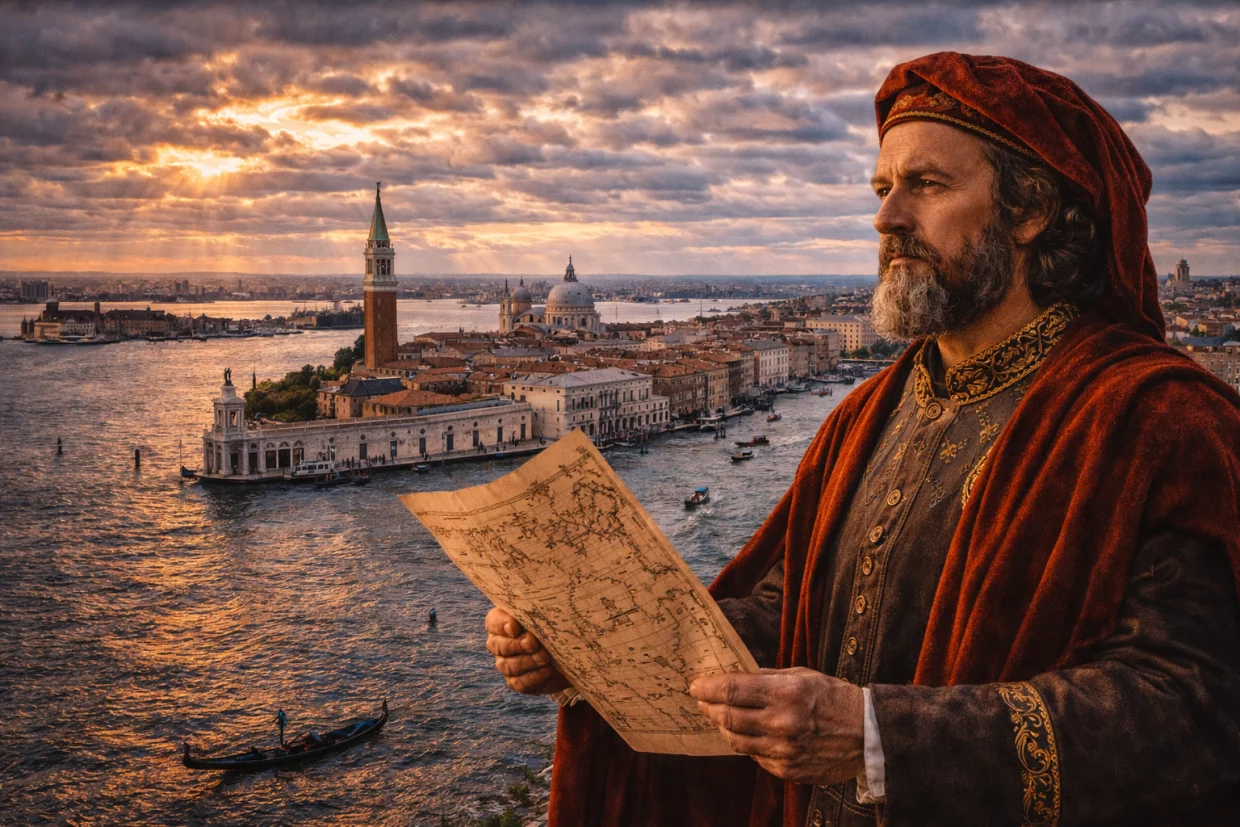
Location & Historical Background
Romantic Setting
Venice lies in a vast lagoon on the Adriatic Sea, spread across more than a hundred small islands connected by bridges and canals. There are no cars, only boats, footsteps, and echoes bouncing off stone façades. Today, visitors are mesmerized by the way light, water, and architecture merge into a city that feels unreal—and yet stubbornly alive.
Origins & Foundation
Venice emerged in the 5th–6th centuries, founded by refugees fleeing barbarian invasions on the mainland. Legend claims the city was born out of fear and mud—and somehow turned both into gold. By mastering shipbuilding and trade, Venice grew from a lagoon refuge into a maritime superpower.
The Three Greatest Blows
Fall of Constantinople (1453)
When Constantinople fell in 1453, Venice lost a crucial trading partner and gateway to the East. The city’s economic dominance began to weaken as global trade routes shifted.
Napoleonic Conquest (1797)
In 1797, Napoleon ended the Venetian Republic after more than 1,000 years. The Doge abdicated, independence vanished, and Venice’s political power dissolved almost overnight.
Flooding and Environmental Threats (20th–21st Centuries)
From the 20th century onward, rising sea levels, mass tourism, and subsidence have increasingly threatened Venice’s survival. Flooding events (acqua alta) became more frequent, forcing the city into an ongoing battle with nature and time.
The Golden Age
Venice’s golden age spanned the 13th to 16th centuries, when it ruled Mediterranean trade. Wealth from commerce funded palaces, art, diplomacy, and a powerful navy—making Venice one of the richest and most influential cities in Europe.
Why Visit the City Today
Today, Venice is fragile, crowded, breathtaking, and utterly singular. Its art, architecture, museums, and quiet backstreets still reward those who slow down and wander beyond the obvious routes. Venice is not about efficiency—it’s about atmosphere, reflection, and learning to move at the city’s pace.
Tourist Information & Must-See Places
Practical Information (Estimated Averages)
- Average lunch: €15–20
- Average accommodation (per night): €140–250
- One beer: €5–7
- One coffee (espresso): €2–4
Most Interesting Parts of the City
San Marco district, Dorsoduro, Cannaregio, Grand Canal, and the quieter residential islands.
Top 3 Must-See Attractions
St. Mark’s Square & Basilica
The ceremonial heart of Venice, where Byzantine splendor, political power, and ritual once defined the republic’s identity.
Doge’s Palace
A masterpiece of Gothic architecture that served as the seat of Venetian government—revealing how beauty and authority were inseparable here.
Grand Canal
Venice’s main artery, lined with palaces that tell the story of wealth, trade, and competition best understood from a boat.
Final Summary
Venice doesn’t ask you to understand it—it asks you to surrender. Come for the beauty and history, stay for the silence between footsteps, and leave knowing that some cities don’t belong to the future—they belong to memory.
Tags: Italy