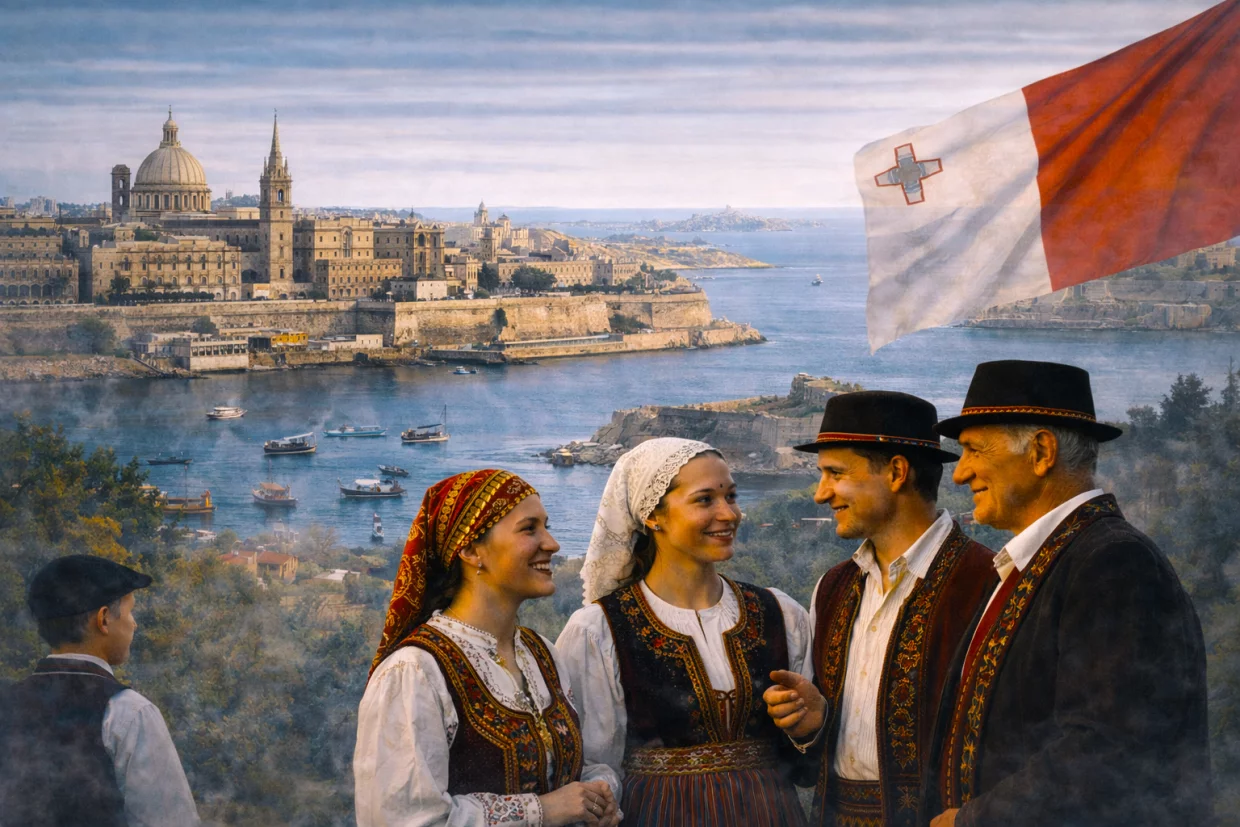
What’s the problem right now?
Malta is successful — and overstretched.
It has:
- strong economic growth
- strategic location
- EU membership with influence beyond size
- flexible, service-based economy
But also:
- extreme population density
- pressure on infrastructure
- governance controversies
- limited capacity for error
Malta isn’t collapsing. It is running at maximum density.
Growth arrived faster than institutions could adapt — and there is nowhere to expand into.
How history taught Malta to survive by being useful
Malta’s history is a sequence of occupations.
Phoenicians, Romans, Arabs, Knights, British —
everyone passed through.
Few asked.
The lesson absorbed:
You don’t control history — you position yourself within it.
Malta learned to be:
- strategic
- cooperative
- indispensable
Even mythology reflects this. The island isn’t about heroes — it’s about endurance.
Later, British rule left institutions, language, and legal systems that Malta adapted pragmatically rather than rejected.
Independence didn’t erase dependence. It rebranded it.
Speed, visibility, and fragile trust
Malta’s greatest strength is speed.
Strengths:
- fast decision-making
- adaptability
- openness to foreign capital
- political flexibility
Limits:
- blurred boundaries between power and business
- weak oversight
- reputational vulnerability
- limited checks and balances
When the state is small,
everyone knows everyone —
and accountability becomes complicated.
Figures like Daphne Caruana Galizia exposed how dangerous that proximity can become.
Her assassination wasn’t just a crime —
it was a national trauma that revealed institutional fragility.
The limits of hyper-visibility
In Malta, nothing disappears quietly.
Challenges today:
- restoring trust
- balancing openness with regulation
- protecting rule of law
- managing environmental and housing pressure
Malta benefits from globalization — but absorbs its risks immediately.
Mistakes aren’t abstract. They are next door.
What could realistically help?
Option 1: Strengthen institutions faster than growth
Speed without oversight invites damage.
Pros: credibility
Cons: friction
Option 2: Treat reputation as infrastructure
Trust isn’t symbolic for Malta — it’s economic necessity.
Pros: resilience
Cons: constraint
Option 3: Slow down strategically
Not all growth is worth absorbing.
Final thought
Malta proves that Europe’s smallest members experience its pressures first — and hardest.
Its challenge now is simple and unforgiving: to prove that size doesn’t excuse fragility, and that visibility can be turned into accountability.
In a continent where distance often hides mistakes, Malta reminds everyone what happens when there is nowhere to look away.
Tags: